| 所在主题: | |
| 文件名: TOC.pdf | |
| 资料下载链接地址: https://bbs.pinggu.org/a-1428205.html | |
| 附件大小: | |
|
Neural Networks and Intellect: Using Model-Based ConceptsLeonid I. Perlovsky 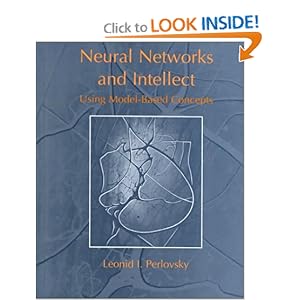 Publication Date: October 19, 2000 | ISBN-10: 0195111621 | ISBN-13: 978-0195111620 | Edition: 1 Neural Networks and Intellect: Using Model-Based Concepts describes a new mathematical concept of modeling field theory and its applications to a variety of problems. Examining the relationships among mathematics, computations in neural networks, signs and symbols in semiotics, and ideas of mind in psychology and philosophy, this unique text discusses deep philosophical questions in detail and relates them to mathematics and the engineering of intelligence. Ideal for courses in neural networks, modern pattern recognition, and mathematical concepts of intelligence, it will also be of interest to anyone working in a variety of fields including neural networks, AI, cognitive science, fuzzy systems, pattern recognition and machine/computer vision, data mining, robotics, target tracking, and financial forecasting. Neural Networks and Intellect describes model-based neural networks that utilize the intriguing concept of an internal "world" model, an idea that originated in artificial intelligence and cognitive psychology but whose roots date back to Plato and Aristotle. Combining the a priori knowledge with adaptive learning, the new mathematical concept addresses the most perplexing problems in the field of neural networks: fast learning and robust generalization. The author provides an overview of computational intelligence and neural networks, relating hundreds of seemingly disparate techniques to several fundamental mathematical concepts, which are in turn linked to concepts of mind in philosophy, psychology, and linguistics. Topics covered include the hierarchical and heterarchical organization of intelligent systems, statistical learning theory, genetic algorithms, complex adaptive systems, mathematical semiotics, the dynamic nature of symbols, Godel theorems and intelligence, emotions and thinking, the mathematics of emotional intellect, consciousness, and more. Perlovsky's remarkable conclusion is that the work of ancient philosophers came closer to the computational concepts emerging today than that of pattern recognition and AI experts of just a few years ago. The following website contains information about Dr. Perlovsky's current research related to the theory developed in the book and about available funding opportunities under a Research Associateship Program: to find it search for Perlovsky on http://www4/nationalacademies.org/pga/rap.nsf. Other sources of funding might be available for US-based and international researchers. |
|
 熟悉论坛请点击新手指南
|
|
| 下载说明 | |
|
1、论坛支持迅雷和网际快车等p2p多线程软件下载,请在上面选择下载通道单击右健下载即可。 2、论坛会定期自动批量更新下载地址,所以请不要浪费时间盗链论坛资源,盗链地址会很快失效。 3、本站为非盈利性质的学术交流网站,鼓励和保护原创作品,拒绝未经版权人许可的上传行为。本站如接到版权人发出的合格侵权通知,将积极的采取必要措施;同时,本站也将在技术手段和能力范围内,履行版权保护的注意义务。 (如有侵权,欢迎举报) |
|

京ICP备16021002号-2 京B2-20170662号
 京公网安备 11010802022788号
论坛法律顾问:王进律师
知识产权保护声明
免责及隐私声明
用户协议
京公网安备 11010802022788号
论坛法律顾问:王进律师
知识产权保护声明
免责及隐私声明
用户协议




