| 所在主题: | |
| 文件名: Derivatives Analytics with Python_ Data Analysis, Models, Stion and Hedging (The.pdf | |
| 资料下载链接地址: https://bbs.pinggu.org/a-1830808.html | |
| 附件大小: | |
|
Supercharge options analytics and hedging using the power of Python
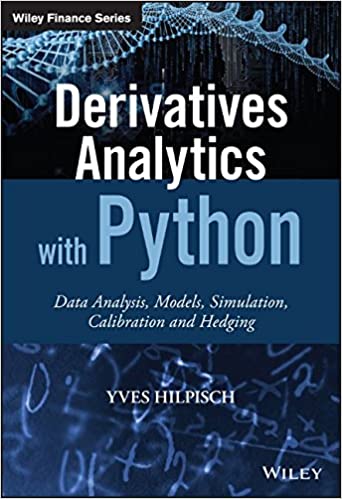
Derivatives Analytics with Python shows you how to implement market-consistent valuation and hedging approaches using advanced financial models, efficient numerical techniques, and the powerful capabilities of the Python programming language. This unique guide offers detailed explanations of all theory, methods, and processes, giving you the background and tools necessary to value stock index options from a sound foundation. You'll find and use self-contained Python scripts and modules and learn how to apply Python to advanced data and derivatives analytics as you benefit from the 5,000+ lines of code that are provided to help you reproduce the results and graphics presented. Coverage includes market data analysis, risk-neutral valuation, Monte Carlo simulation, model calibration, valuation, and dynamic hedging, with models that exhibit stochastic volatility, jump components, stochastic short rates, and more. The companion website features all code and IPython Notebooks for immediate execution and automation. Python is gaining ground in the derivatives analytics space, allowing institutions to quickly and efficiently deliver portfolio, trading, and risk management results. This book is the finance professional's guide to exploiting Python's capabilities for efficient and performing derivatives analytics.
Recent developments in the Python ecosystem enable analysts to implement analytics tasks as performing as with C or C++, but using only about one-tenth of the code or even less. Derivatives Analytics with Python — Data Analysis, Models, Simulation, Calibration and Hedging shows you what you need to know to supercharge your derivatives and risk analytics efforts. Editorial ReviewsFrom the Inside FlapMarket-based valuation of stock index options is an essential task for every buy-side and sell-side decision maker in the derivatives analytics domain. In Derivatives Analytics with Python, you'll discover why Python has established itself in the financial industry and how to leverage this powerful programming language so you can implement market-consistent valuation and hedging approaches. Written for Quant developers, traders, risk managers, compliance officers, and model validators, this reliable resource skillfully covers the four areas necessary to effectively value options: market-based valuation as a process; sound market model; numerical techniques; and technology. Presented in three parts, Part One looks at the risks affecting the value of equity index options and empirical facts regarding stocks and interest rates. Part Two covers arbitrage pricing theory, risk-neutral valuation in discrete time, continuous time, and introduces the two popular methods of Carr-Madan and Lewis for Fourier-based option pricing. Finally, Part Three considers the whole process of a market-based valuation effort and the Monte Carlo simulation as the method of choice for the valuation of exotic and complex index options and derivatives. Practical and informative, with self-contained Python scripts and modules and 5,000+ lines of code provided to help you reproduce the results and graphics presented. In addition, the companion website (http://wiley. quant-platform.com) features all code and IPython Notebooks for immediate execution and automation. Author Yves Hilpisch explores market-based valuation as a process, as well as empirical findings about market realities. By reading this book, you'll be equipped to develop much-needed tools during a market-based valuation with balanced coverage of:
From the Back Cover Praise for Derivatives Analytics with Python "Another excellent offering from Dr Hilpisch. This book has a very good coverage of derivatives analytics and their implementations in Python." "A thorough overview of the state of the art in equity derivatives pricing and how to apply it using Python, with an implementer's eye to detail." "There is currently much excitement about the application of Python to Quant Finance in both academia and the financial markets. Yves' monumental undertaking guides the reader through the mathematical and numerical aspects of derivative valuation with programming in Python, in an expert and pedagogical manner. I will be making his publication the standard text for all my Computational Finance courses." "A must read for any practitioner who is serious about implementing Python across their derivatives platform. Dr Hilpisch excels at simplifying complex state-of-the-art techniques for both the pricing and hedging of derivatives in Python that both operators and academics will appreciate."
Product Details
|
|
 熟悉论坛请点击新手指南
|
|
| 下载说明 | |
|
1、论坛支持迅雷和网际快车等p2p多线程软件下载,请在上面选择下载通道单击右健下载即可。 2、论坛会定期自动批量更新下载地址,所以请不要浪费时间盗链论坛资源,盗链地址会很快失效。 3、本站为非盈利性质的学术交流网站,鼓励和保护原创作品,拒绝未经版权人许可的上传行为。本站如接到版权人发出的合格侵权通知,将积极的采取必要措施;同时,本站也将在技术手段和能力范围内,履行版权保护的注意义务。 (如有侵权,欢迎举报) |
|

京ICP备16021002号-2 京B2-20170662号
 京公网安备 11010802022788号
论坛法律顾问:王进律师
知识产权保护声明
免责及隐私声明
京公网安备 11010802022788号
论坛法律顾问:王进律师
知识产权保护声明
免责及隐私声明