| 所在主题: | |
| 文件名: 164140.pdf | |
| 资料下载链接地址: https://bbs.pinggu.org/a-164140.html | |
| 附件大小: | |
|
<p>Title:An Introduction to Modern Econometrics Using Stata<br/>
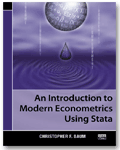 <br/>Author: Christopher F. Baum <br/>Publisher: Stata Press <br/>Copyright: 2006 <br/>Contents</p><p>1 Introduction<br/>1.1 An overview of Stata's distinctive features <br/>1.2 Installing the necessary software <br/>1.3 Installing the support materials</p><p>2 Working with economic and financial data in Stata <br/>2.1 The basics <br/>2.1.1 The use command <br/>2.1.2 Variable types <br/>2.1.3 _n and _N <br/>2.1.4 generate and replace <br/>2.1.5 sort and gsort <br/>2.1.6 if exp and in range <br/>2.1.7 Using if exp with indicator variables <br/>2.1.8 Using if exp versus by varlist: with statistical commands <br/>2.1.9 Labels and notes <br/>2.1.10 The varlist <br/>2.1.11 drop and keep <br/>2.1.12 rename and renvars <br/>2.1.13 The save command <br/>2.1.14 insheet and infile <br/>2.2 Common data transformations <br/>2.2.1 The cond() function <br/>2.2.2 Recoding discrete and continuous variables <br/>2.2.3 Handling missing data <br/>mvdecode and mvencode <br/>2.2.4 String-to-numeric conversion and vice versa <br/>2.2.5 Handling dates <br/>2.2.6 Some useful functions for generate or replace <br/>2.2.7 The egen command <br/>Official egen functions <br/>egen functions from the user community <br/>2.2.8 Computation for by-groups <br/>2.2.9 Local macros <br/>2.2.10 Looping over variables: forvalues and foreach <br/>2.2.11 Scalars and matrices <br/>2.2.12 Command syntax and return values </p><p>3 Organizing and handling economic data <br/>3.1 Cross-sectional data and identifier variables <br/>3.2 Time-series data <br/>3.2.1 Time-series operators <br/>3.3 Pooled cross-sectional time-series data <br/>3.4 Panel data <br/>3.4.1 Operating on panel data <br/>3.5 Tools for manipulating panel data <br/>3.5.1 Unbalanced panels and data screening <br/>3.5.2 Other transforms of panel data <br/>3.5.3 Moving-window summary statistics and correlations <br/>3.6 Combining cross-sectional and time-series datasets <br/>3.7 Creating long-format datasets with append <br/>3.7.1 Using merge to add aggregate characteristics <br/>3.7.2 The dangers of many-to-many merges <br/>3.8 The reshape command <br/>3.8.1 The xpose command <br/>3.9 Using Stata for reproducible research <br/>3.9.1 Using do-files <br/>3.9.2 Data validation: assert and duplicates </p><p>4 Linear regression <br/>4.1 Introduction <br/>4.2 Computing linear regression estimates <br/>4.2.1 Regression as a method-of-moments estimator <br/>4.2.2 The sampling distribution of regression estimates <br/>4.2.3 Efficiency of the regression estimator <br/>4.2.4 Numerical identification of the regression estimates <br/>4.3 Interpreting regression estimates <br/>4.3.1 Research project: A study of single-family housing prices <br/>4.3.2 The ANOVA table: ANOVA F and R-squared <br/>4.3.3 Adjusted R-squared <br/>4.3.4 The coefficient estimates and beta coefficients <br/>4.3.5 Regression without a constant term <br/>4.3.6 Recovering estimation results <br/>4.3.7 Detecting collinearity in regression <br/>4.4 Presenting regression estimates <br/>4.4.1 Presenting summary statistics and correlations <br/>4.5 Hypothesis tests, linear restrictions, and constrained least squares <br/>4.5.1 Wald tests with test <br/>4.5.2 Wald tests involving linear combinations of parameters <br/>4.5.3 Joint hypothesis tests <br/>4.5.4 Testing nonlinear restrictions and forming nonlinear combinations <br/>4.5.5 Testing competing (nonnested) models <br/>4.6 Computing residuals and predicted values <br/>4.6.1 Computing interval predictions <br/>4.7 Computing marginal effects <br/>4.A Appendix: Regression as a least-squares estimator <br/>4.B Appendix: The large-sample VCE for linear regression </p><p>5 Specifying the functional form <br/>5.1 Introduction <br/>5.2 Specification error <br/>5.2.1 Omitting relevant variables from the model <br/>Specifying dynamics in time-series regression models <br/>5.2.2 Graphically analyzing regression data <br/>5.2.3 Added-variable plots <br/>5.2.4 Including irrelevant variables in the model <br/>5.2.5 The asymmetry of specification error <br/>5.2.6 Misspecification of the functional form <br/>5.2.7 Ramsey's RESET <br/>5.2.8 Specification plots <br/>5.2.9 Specification and interaction terms <br/>5.2.10 Outlier statistics and measures of leverage <br/>The DFITS statistic <br/>The DFBETA statistic <br/>5.3 Endogeneity and measurement error </p><p>6 Regression with non-i.i.d. errors <br/>6.1 The generalized linear regression model <br/>6.1.1 Types of deviations from i.i.d. errors <br/>6.1.2 The robust estimator of VCE <br/>6.1.3 The cluster estimator of VCE <br/>6.1.4 The Newey–West estimator of VCE <br/>6.1.5 The generalized-least squares estimator <br/>The FGLS estimator <br/>6.2 Heteroskedasticity in the error distribution <br/>6.2.1 Heteroskedasticity related to scale <br/>Testing for heteroskedasticity related to scale <br/>FGLS estimation <br/>6.2.2 Heteroskedasticity between groups of observations <br/>Testing for heteroskedasticity between groups of observations <br/>FGLS estimation <br/>6.2.3 Heteroskedasticity in grouped data <br/>FGLS estimation <br/>6.3 Serial correlation in the error distribution <br/>6.3.1 Testing for serial correlation <br/>6.3.2 FGLS estimation with serial correlation </p><p>7 Regression with indicator variables <br/>7.1 Testing for significance of a qualitative factor <br/>7.1.1 Regression with one qualitative measure <br/>7.1.2 Regression with two qualitative measures <br/>Interaction effects <br/>7.2 Regression with qualitative and quantitative factors <br/>Testing for slope differences <br/>7.3 Seasonal adjustment with indicator variables <br/>7.4 Testing for structural stability and structural change <br/>7.4.1 Constraints of continuity and differentiability <br/>7.4.2 Structural change in a time-series model </p><p>8 Instrumental-variables estimators <br/>8.1 Introduction <br/>8.2 Endogeneity in economic relationships <br/>8.3 2SLS <br/>8.4 The ivreg command <br/>8.5 Identification and tests of overidentifying restrictions <br/>8.6 Computing IV estimates <br/>8.7 ivreg2 and GMM estimation <br/>8.7.1 The GMM estimator <br/>8.7.2 GMM in a homoskedastic context <br/>8.7.3 GMM and heteroskedasticity-consistent standard errors <br/>8.7.4 GMM and clustering <br/>8.7.5 GMM and HAC standard errors <br/>8.8 Testing and overidentifying restrictions in GMM <br/>8.8.1 Testing a subset of the overidentifying restrictions in GMM <br/>8.9 Testing for heteroskedasticity in the IV context <br/>8.10 Testing the relevance of instruments <br/>8.11 Durbin–Wu–Hausman tests for endogeneity in IV estimation <br/>8.A Appendix: Omitted-variables bias <br/>8.B Appendix: Measurement error <br/>8.B.1 Solving errors-in-variables problems </p><p>9 Panel-data models <br/>9.1 FE and RE models <br/>9.1.1 One-way FE <br/>9.1.2 Time effects and two-way FE <br/>9.1.3 The between estimator <br/>9.1.4 One-way RE <br/>9.1.5 Testing the appropriateness of RE <br/>9.1.6 Prediction from one-way FE and RE <br/>9.2 IV models for panel data <br/>9.3 Dynamic panel-data models <br/>9.4 Seemingly unrelated regression models <br/>9.4.1 SUR with identical regressors <br/>9.5 Moving-window regression estimates </p><p>10 Models of discrete and limited dependent variables <br/>10.1 Binomial logit and probit models <br/>10.1.1 The latent-variable approach <br/>10.1.2 Marginal effects and predictions <br/>Binomial probit <br/>Binomial logit and grouped logit <br/>10.1.3 Evaluating specification and goodness of fit <br/>10.2 Ordered logit and probit models <br/>10.3 Truncated regression and tobit models <br/>10.3.1 Truncation <br/>10.3.2 Censoring <br/>10.4 Incidental truncation and sample-selection models <br/>10.5 Bivariate probit and probit with selection <br/>10.5.1 Binomial probit with selection </p><p>A Getting the data into Stata <br/>A.1 Inputting data from ASCII text files and spreadsheets <br/>A.1.1 Handling text files <br/>Free format versus fixed format <br/>The insheet command <br/>A.1.2 Accessing data stored in spreadsheets <br/>A.1.3 Fixed-format data files <br/>A.2 Importing data from other package formats </p><p>B The basics of Stata programming <br/>B.1 Local and global macros <br/>B.1.1 Global macros <br/>B.1.2 Extended macro functions and list functions <br/>B.2 Scalars <br/>B.3 Loop constructs <br/>B.3.1 foreach <br/>B.4 Matrices <br/>B.5 return and ereturn <br/>B.5.1 ereturn list <br/>B.6 The program and syntax statements <br/>B.7 Using Mata functions in Stata programs </p><p>References </p><p>不好意思,花了整整一天时间[]都没传上本论坛,只好外链了<br/>http://download1.gbaopan.com/e30 ... p?supplierID=173132<br/>请大家根据各自网络情况选择网通下载或电信下载,支持Flashget和迅雷</p><p> </p><br/> <br/>Author: Christopher F. Baum <br/>Publisher: Stata Press <br/>Copyright: 2006 <br/>Contents</p><p>1 Introduction<br/>1.1 An overview of Stata's distinctive features <br/>1.2 Installing the necessary software <br/>1.3 Installing the support materials</p><p>2 Working with economic and financial data in Stata <br/>2.1 The basics <br/>2.1.1 The use command <br/>2.1.2 Variable types <br/>2.1.3 _n and _N <br/>2.1.4 generate and replace <br/>2.1.5 sort and gsort <br/>2.1.6 if exp and in range <br/>2.1.7 Using if exp with indicator variables <br/>2.1.8 Using if exp versus by varlist: with statistical commands <br/>2.1.9 Labels and notes <br/>2.1.10 The varlist <br/>2.1.11 drop and keep <br/>2.1.12 rename and renvars <br/>2.1.13 The save command <br/>2.1.14 insheet and infile <br/>2.2 Common data transformations <br/>2.2.1 The cond() function <br/>2.2.2 Recoding discrete and continuous variables <br/>2.2.3 Handling missing data <br/>mvdecode and mvencode <br/>2.2.4 String-to-numeric conversion and vice versa <br/>2.2.5 Handling dates <br/>2.2.6 Some useful functions for generate or replace <br/>2.2.7 The egen command <br/>Official egen functions <br/>egen functions from the user community <br/>2.2.8 Computation for by-groups <br/>2.2.9 Local macros <br/>2.2.10 Looping over variables: forvalues and foreach <br/>2.2.11 Scalars and matrices <br/>2.2.12 Command syntax and return values </p><p>3 Organizing and handling economic data <br/>3.1 Cross-sectional data and identifier variables <br/>3.2 Time-series data <br/>3.2.1 Time-series operators <br/>3.3 Pooled cross-sectional time-series data <br/>3.4 Panel data <br/>3.4.1 Operating on panel data <br/>3.5 Tools for manipulating panel data <br/>3.5.1 Unbalanced panels and data screening <br/>3.5.2 Other transforms of panel data <br/>3.5.3 Moving-window summary statistics and correlations <br/>3.6 Combining cross-sectional and time-series datasets <br/>3.7 Creating long-format datasets with append <br/>3.7.1 Using merge to add aggregate characteristics <br/>3.7.2 The dangers of many-to-many merges <br/>3.8 The reshape command <br/>3.8.1 The xpose command <br/>3.9 Using Stata for reproducible research <br/>3.9.1 Using do-files <br/>3.9.2 Data validation: assert and duplicates </p><p>4 Linear regression <br/>4.1 Introduction <br/>4.2 Computing linear regression estimates <br/>4.2.1 Regression as a method-of-moments estimator <br/>4.2.2 The sampling distribution of regression estimates <br/>4.2.3 Efficiency of the regression estimator <br/>4.2.4 Numerical identification of the regression estimates <br/>4.3 Interpreting regression estimates <br/>4.3.1 Research project: A study of single-family housing prices <br/>4.3.2 The ANOVA table: ANOVA F and R-squared <br/>4.3.3 Adjusted R-squared <br/>4.3.4 The coefficient estimates and beta coefficients <br/>4.3.5 Regression without a constant term <br/>4.3.6 Recovering estimation results <br/>4.3.7 Detecting collinearity in regression <br/>4.4 Presenting regression estimates <br/>4.4.1 Presenting summary statistics and correlations <br/>4.5 Hypothesis tests, linear restrictions, and constrained least squares <br/>4.5.1 Wald tests with test <br/>4.5.2 Wald tests involving linear combinations of parameters <br/>4.5.3 Joint hypothesis tests <br/>4.5.4 Testing nonlinear restrictions and forming nonlinear combinations <br/>4.5.5 Testing competing (nonnested) models <br/>4.6 Computing residuals and predicted values <br/>4.6.1 Computing interval predictions <br/>4.7 Computing marginal effects <br/>4.A Appendix: Regression as a least-squares estimator <br/>4.B Appendix: The large-sample VCE for linear regression </p><p>5 Specifying the functional form <br/>5.1 Introduction <br/>5.2 Specification error <br/>5.2.1 Omitting relevant variables from the model <br/>Specifying dynamics in time-series regression models <br/>5.2.2 Graphically analyzing regression data <br/>5.2.3 Added-variable plots <br/>5.2.4 Including irrelevant variables in the model <br/>5.2.5 The asymmetry of specification error <br/>5.2.6 Misspecification of the functional form <br/>5.2.7 Ramsey's RESET <br/>5.2.8 Specification plots <br/>5.2.9 Specification and interaction terms <br/>5.2.10 Outlier statistics and measures of leverage <br/>The DFITS statistic <br/>The DFBETA statistic <br/>5.3 Endogeneity and measurement error </p><p>6 Regression with non-i.i.d. errors <br/>6.1 The generalized linear regression model <br/>6.1.1 Types of deviations from i.i.d. errors <br/>6.1.2 The robust estimator of VCE <br/>6.1.3 The cluster estimator of VCE <br/>6.1.4 The Newey–West estimator of VCE <br/>6.1.5 The generalized-least squares estimator <br/>The FGLS estimator <br/>6.2 Heteroskedasticity in the error distribution <br/>6.2.1 Heteroskedasticity related to scale <br/>Testing for heteroskedasticity related to scale <br/>FGLS estimation <br/>6.2.2 Heteroskedasticity between groups of observations <br/>Testing for heteroskedasticity between groups of observations <br/>FGLS estimation <br/>6.2.3 Heteroskedasticity in grouped data <br/>FGLS estimation <br/>6.3 Serial correlation in the error distribution <br/>6.3.1 Testing for serial correlation <br/>6.3.2 FGLS estimation with serial correlation </p><p>7 Regression with indicator variables <br/>7.1 Testing for significance of a qualitative factor <br/>7.1.1 Regression with one qualitative measure <br/>7.1.2 Regression with two qualitative measures <br/>Interaction effects <br/>7.2 Regression with qualitative and quantitative factors <br/>Testing for slope differences <br/>7.3 Seasonal adjustment with indicator variables <br/>7.4 Testing for structural stability and structural change <br/>7.4.1 Constraints of continuity and differentiability <br/>7.4.2 Structural change in a time-series model </p><p>8 Instrumental-variables estimators <br/>8.1 Introduction <br/>8.2 Endogeneity in economic relationships <br/>8.3 2SLS <br/>8.4 The ivreg command <br/>8.5 Identification and tests of overidentifying restrictions <br/>8.6 Computing IV estimates <br/>8.7 ivreg2 and GMM estimation <br/>8.7.1 The GMM estimator <br/>8.7.2 GMM in a homoskedastic context <br/>8.7.3 GMM and heteroskedasticity-consistent standard errors <br/>8.7.4 GMM and clustering <br/>8.7.5 GMM and HAC standard errors <br/>8.8 Testing and overidentifying restrictions in GMM <br/>8.8.1 Testing a subset of the overidentifying restrictions in GMM <br/>8.9 Testing for heteroskedasticity in the IV context <br/>8.10 Testing the relevance of instruments <br/>8.11 Durbin–Wu–Hausman tests for endogeneity in IV estimation <br/>8.A Appendix: Omitted-variables bias <br/>8.B Appendix: Measurement error <br/>8.B.1 Solving errors-in-variables problems </p><p>9 Panel-data models <br/>9.1 FE and RE models <br/>9.1.1 One-way FE <br/>9.1.2 Time effects and two-way FE <br/>9.1.3 The between estimator <br/>9.1.4 One-way RE <br/>9.1.5 Testing the appropriateness of RE <br/>9.1.6 Prediction from one-way FE and RE <br/>9.2 IV models for panel data <br/>9.3 Dynamic panel-data models <br/>9.4 Seemingly unrelated regression models <br/>9.4.1 SUR with identical regressors <br/>9.5 Moving-window regression estimates </p><p>10 Models of discrete and limited dependent variables <br/>10.1 Binomial logit and probit models <br/>10.1.1 The latent-variable approach <br/>10.1.2 Marginal effects and predictions <br/>Binomial probit <br/>Binomial logit and grouped logit <br/>10.1.3 Evaluating specification and goodness of fit <br/>10.2 Ordered logit and probit models <br/>10.3 Truncated regression and tobit models <br/>10.3.1 Truncation <br/>10.3.2 Censoring <br/>10.4 Incidental truncation and sample-selection models <br/>10.5 Bivariate probit and probit with selection <br/>10.5.1 Binomial probit with selection </p><p>A Getting the data into Stata <br/>A.1 Inputting data from ASCII text files and spreadsheets <br/>A.1.1 Handling text files <br/>Free format versus fixed format <br/>The insheet command <br/>A.1.2 Accessing data stored in spreadsheets <br/>A.1.3 Fixed-format data files <br/>A.2 Importing data from other package formats </p><p>B The basics of Stata programming <br/>B.1 Local and global macros <br/>B.1.1 Global macros <br/>B.1.2 Extended macro functions and list functions <br/>B.2 Scalars <br/>B.3 Loop constructs <br/>B.3.1 foreach <br/>B.4 Matrices <br/>B.5 return and ereturn <br/>B.5.1 ereturn list <br/>B.6 The program and syntax statements <br/>B.7 Using Mata functions in Stata programs </p><p>References </p><p>不好意思,花了整整一天时间[]都没传上本论坛,只好外链了<br/>http://download1.gbaopan.com/e30 ... p?supplierID=173132<br/>请大家根据各自网络情况选择网通下载或电信下载,支持Flashget和迅雷</p><p> </p><br/>[此贴子已经被蓝色于2007-10-14 21:31:29编辑过] |
|
 熟悉论坛请点击新手指南
|
|
| 下载说明 | |
|
1、论坛支持迅雷和网际快车等p2p多线程软件下载,请在上面选择下载通道单击右健下载即可。 2、论坛会定期自动批量更新下载地址,所以请不要浪费时间盗链论坛资源,盗链地址会很快失效。 3、本站为非盈利性质的学术交流网站,鼓励和保护原创作品,拒绝未经版权人许可的上传行为。本站如接到版权人发出的合格侵权通知,将积极的采取必要措施;同时,本站也将在技术手段和能力范围内,履行版权保护的注意义务。 (如有侵权,欢迎举报) |
|

京ICP备16021002号-2 京B2-20170662号
 京公网安备 11010802022788号
论坛法律顾问:王进律师
知识产权保护声明
免责及隐私声明
京公网安备 11010802022788号
论坛法律顾问:王进律师
知识产权保护声明
免责及隐私声明




