


 发帖
发帖
 雷达卡
雷达卡


Title:An Introduction to Modern Econometrics Using Stata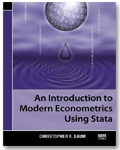
Author: Christopher F. Baum
Publisher: Stata Press
Copyright: 2006
Contents
1 Introduction
1.1 An overview of Stata's distinctive features
1.2 Installing the necessary software
1.3 Installing the support materials
2 Working with economic and financial data in Stata
2.1 The basics
2.1.1 The use command
2.1.2 Variable types
2.1.3 _n and _N
2.1.4 generate and replace
2.1.5 sort and gsort
2.1.6 if exp and in range
2.1.7 Using if exp with indicator variables
2.1.8 Using if exp versus by varlist: with statistical commands
2.1.9 Labels and notes
2.1.10 The varlist
2.1.11 drop and keep
2.1.12 rename and renvars
2.1.13 The save command
2.1.14 insheet and infile
2.2 Common data transformations
2.2.1 The cond() function
2.2.2 Recoding discrete and continuous variables
2.2.3 Handling missing data
mvdecode and mvencode
2.2.4 String-to-numeric conversion and vice versa
2.2.5 Handling dates
2.2.6 Some useful functions for generate or replace
2.2.7 The egen command
Official egen functions
egen functions from the user community
2.2.8 Computation for by-groups
2.2.9 Local macros
2.2.10 Looping over variables: forvalues and foreach
2.2.11 Scalars and matrices
2.2.12 Command syntax and return values
3 Organizing and handling economic data
3.1 Cross-sectional data and identifier variables
3.2 Time-series data
3.2.1 Time-series operators
3.3 Pooled cross-sectional time-series data
3.4 Panel data
3.4.1 Operating on panel data
3.5 Tools for manipulating panel data
3.5.1 Unbalanced panels and data screening
3.5.2 Other transforms of panel data
3.5.3 Moving-window summary statistics and correlations
3.6 Combining cross-sectional and time-series datasets
3.7 Creating long-format datasets with append
3.7.1 Using merge to add aggregate characteristics
3.7.2 The dangers of many-to-many merges
3.8 The reshape command
3.8.1 The xpose command
3.9 Using Stata for reproducible research
3.9.1 Using do-files
3.9.2 Data validation: assert and duplicates
4 Linear regression
4.1 Introduction
4.2 Computing linear regression estimates
4.2.1 Regression as a method-of-moments estimator
4.2.2 The sampling distribution of regression estimates
4.2.3 Efficiency of the regression estimator
4.2.4 Numerical identification of the regression estimates
4.3 Interpreting regression estimates
4.3.1 Research project: A study of single-family housing prices
4.3.2 The ANOVA table: ANOVA F and R-squared
4.3.3 Adjusted R-squared
4.3.4 The coefficient estimates and beta coefficients
4.3.5 Regression without a constant term
4.3.6 Recovering estimation results
4.3.7 Detecting collinearity in regression
4.4 Presenting regression estimates
4.4.1 Presenting summary statistics and correlations
4.5 Hypothesis tests, linear restrictions, and constrained least squares
4.5.1 Wald tests with test
4.5.2 Wald tests involving linear combinations of parameters
4.5.3 Joint hypothesis tests
4.5.4 Testing nonlinear restrictions and forming nonlinear combinations
4.5.5 Testing competing (nonnested) models
4.6 Computing residuals and predicted values
4.6.1 Computing interval predictions
4.7 Computing marginal effects
4.A Appendix: Regression as a least-squares estimator
4.B Appendix: The large-sample VCE for linear regression
5 Specifying the functional form
5.1 Introduction
5.2 Specification error
5.2.1 Omitting relevant variables from the model
Specifying dynamics in time-series regression models
5.2.2 Graphically analyzing regression data
5.2.3 Added-variable plots
5.2.4 Including irrelevant variables in the model
5.2.5 The asymmetry of specification error
5.2.6 Misspecification of the functional form
5.2.7 Ramsey's RESET
5.2.8 Specification plots
5.2.9 Specification and interaction terms
5.2.10 Outlier statistics and measures of leverage
The DFITS statistic
The DFBETA statistic
5.3 Endogeneity and measurement error
6 Regression with non-i.i.d. errors
6.1 The generalized linear regression model
6.1.1 Types of deviations from i.i.d. errors
6.1.2 The robust estimator of VCE
6.1.3 The cluster estimator of VCE
6.1.4 The Newey–West estimator of VCE
6.1.5 The generalized-least squares estimator
The FGLS estimator
6.2 Heteroskedasticity in the error distribution
6.2.1 Heteroskedasticity related to scale
Testing for heteroskedasticity related to scale
FGLS estimation
6.2.2 Heteroskedasticity between groups of observations
Testing for heteroskedasticity between groups of observations
FGLS estimation
6.2.3 Heteroskedasticity in grouped data
FGLS estimation
6.3 Serial correlation in the error distribution
6.3.1 Testing for serial correlation
6.3.2 FGLS estimation with serial correlation
7 Regression with indicator variables
7.1 Testing for significance of a qualitative factor
7.1.1 Regression with one qualitative measure
7.1.2 Regression with two qualitative measures
Interaction effects
7.2 Regression with qualitative and quantitative factors
Testing for slope differences
7.3 Seasonal adjustment with indicator variables
7.4 Testing for structural stability and structural change
7.4.1 Constraints of continuity and differentiability
7.4.2 Structural change in a time-series model
8 Instrumental-variables estimators
8.1 Introduction
8.2 Endogeneity in economic relationships
8.3 2SLS
8.4 The ivreg command
8.5 Identification and tests of overidentifying restrictions
8.6 Computing IV estimates
8.7 ivreg2 and GMM estimation
8.7.1 The GMM estimator
8.7.2 GMM in a homoskedastic context
8.7.3 GMM and heteroskedasticity-consistent standard errors
8.7.4 GMM and clustering
8.7.5 GMM and HAC standard errors
8.8 Testing and overidentifying restrictions in GMM
8.8.1 Testing a subset of the overidentifying restrictions in GMM
8.9 Testing for heteroskedasticity in the IV context
8.10 Testing the relevance of instruments
8.11 Durbin–Wu–Hausman tests for endogeneity in IV estimation
8.A Appendix: Omitted-variables bias
8.B Appendix: Measurement error
8.B.1 Solving errors-in-variables problems
9 Panel-data models
9.1 FE and RE models
9.1.1 One-way FE
9.1.2 Time effects and two-way FE
9.1.3 The between estimator
9.1.4 One-way RE
9.1.5 Testing the appropriateness of RE
9.1.6 Prediction from one-way FE and RE
9.2 IV models for panel data
9.3 Dynamic panel-data models
9.4 Seemingly unrelated regression models
9.4.1 SUR with identical regressors
9.5 Moving-window regression estimates
10 Models of discrete and limited dependent variables
10.1 Binomial logit and probit models
10.1.1 The latent-variable approach
10.1.2 Marginal effects and predictions
Binomial probit
Binomial logit and grouped logit
10.1.3 Evaluating specification and goodness of fit
10.2 Ordered logit and probit models
10.3 Truncated regression and tobit models
10.3.1 Truncation
10.3.2 Censoring
10.4 Incidental truncation and sample-selection models
10.5 Bivariate probit and probit with selection
10.5.1 Binomial probit with selection
A Getting the data into Stata
A.1 Inputting data from ASCII text files and spreadsheets
A.1.1 Handling text files
Free format versus fixed format
The insheet command
A.1.2 Accessing data stored in spreadsheets
A.1.3 Fixed-format data files
A.2 Importing data from other package formats
B The basics of Stata programming
B.1 Local and global macros
B.1.1 Global macros
B.1.2 Extended macro functions and list functions
B.2 Scalars
B.3 Loop constructs
B.3.1 foreach
B.4 Matrices
B.5 return and ereturn
B.5.1 ereturn list
B.6 The program and syntax statements
B.7 Using Mata functions in Stata programs
References
不好意思,花了整整一天时间[]都没传上本论坛,只好外链了
http://download1.gbaopan.com/e30 ... p?supplierID=173132
请大家根据各自网络情况选择网通下载或电信下载,支持Flashget和迅雷
 164140.pdf
(24.94 MB)
164140.pdf
(24.94 MB)
[此贴子已经被蓝色于2007-10-14 21:31:29编辑过]








 京公网安备 11010802022788号






