


 发帖
发帖
 雷达卡
雷达卡


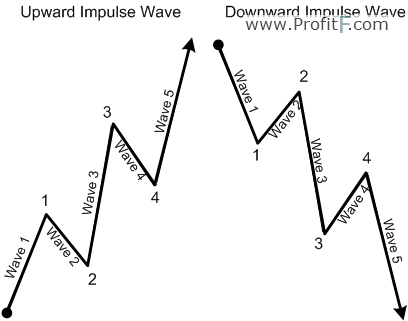
The impulse consists of five waves. Impulse waves always has same direction as the larger trend
3.1 Ideal Impulse Wave:
3. 2. Three main rules for impulse waves in Elliott Wave theory
There are 3 main rules, which anyone who wants to make an Elliott Wave analysis must know.
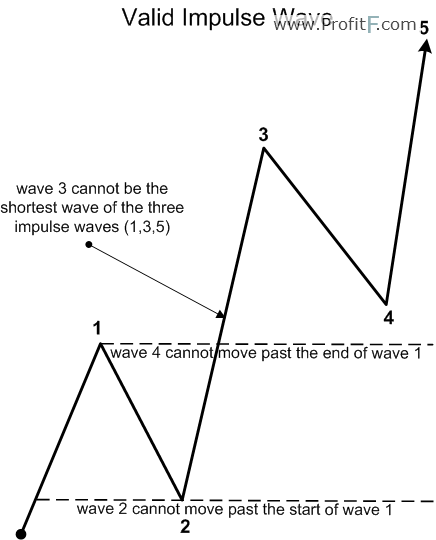
- First rule: Wave 2 cannot retrace the whole wave 1.
- Second rule: Wave 3 cannot be the shortest among waves 1, 3 and 5.
- Third rule: Waves 1 and 4 must not overlap.
See an example below:

3.3. Extension
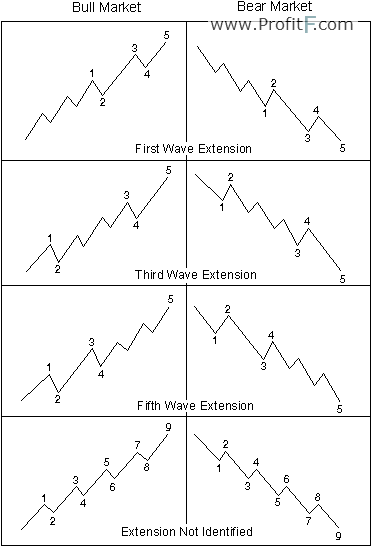
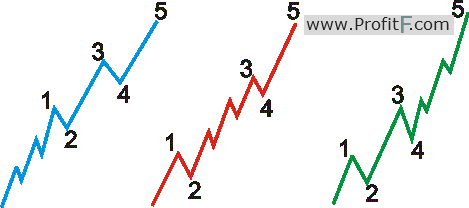
Most impulse waves contain what in Elliott Wave Theory calls an extension. Extensions Elliott waves – impulses with exaggerated sub-waves. The most commonly extended wave – 3th wave
Here an example of extensions in all 3 motive waves:
3.4 Truncation
The good thing is that 90% ot the impulsive waves look like on the above-shown charts. But in some cases there could be surprises. The first alternative is the truncated fifth wave or simply “truncation”.
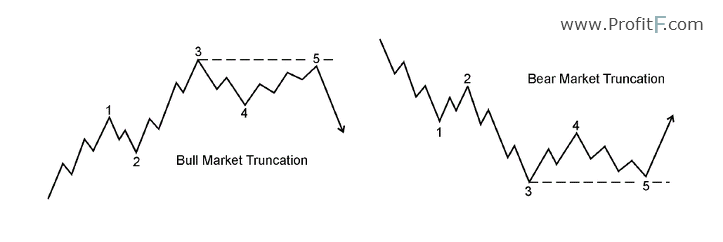
Wave 5 doesn’t exceed the end of wave 3
Everything looks just like a regular impulsive five until we reach the fifth wave. Labeled (5). It does not make a new extreme above or below wave 3. An example is given below.
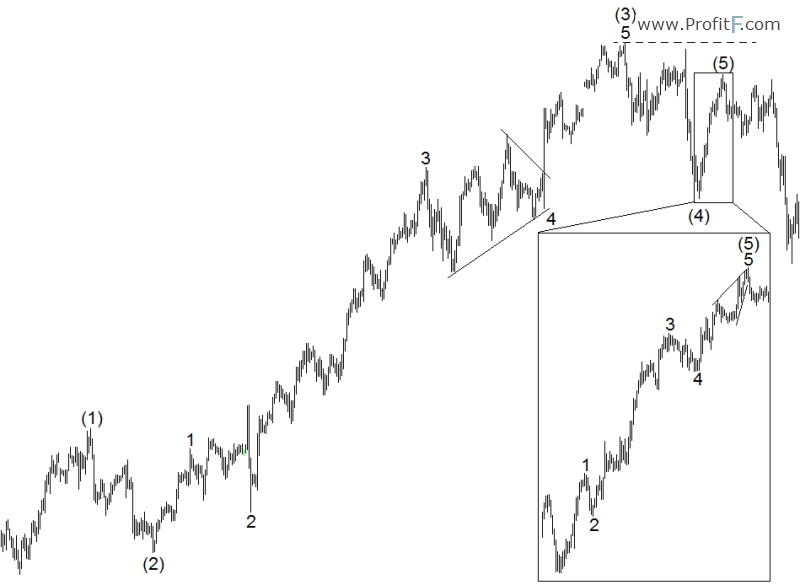
As you can see, the neccesary five waves are here, but wave five falls short. In order to say that a truncation has occured, you have to be able to count five sub-waves in it.
3.5. Diagonals
The other interesting case is the “diagonal”. The diagonal is a pattern, consisting of five waves like in a regular impulse, but waves 1 and 4 tend to overlap. Diagonals develop between two contracting trend lines. You can find a diagonal either in the begining or at the end of the sequence. This means waves 1/A or 5/C.
If the diagonal occurs at the start we call it “leading diagonal”.
If it is in wave 5 or C – “ending diagonal”.
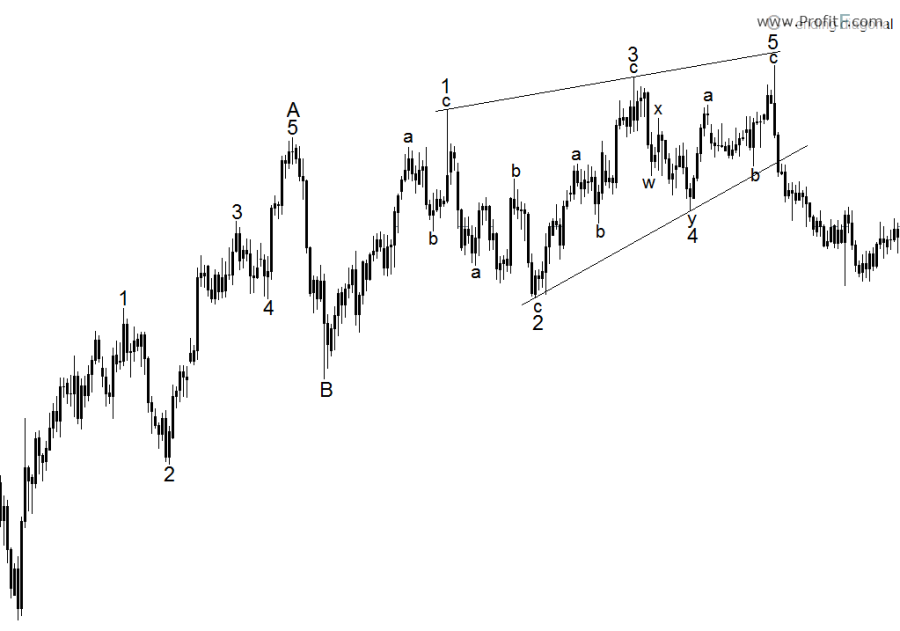
Ending diagonal
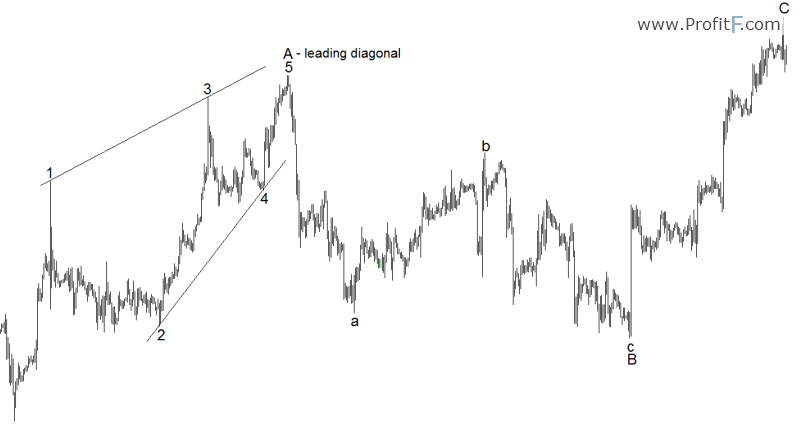
Leading diagonal:
On the first of the two charts above you can see an ending diagonal, since it is in wave C of an A-B-C zig-zag. The second chart depicts a leading diagonal in the position of wave A of the same type of pattern.
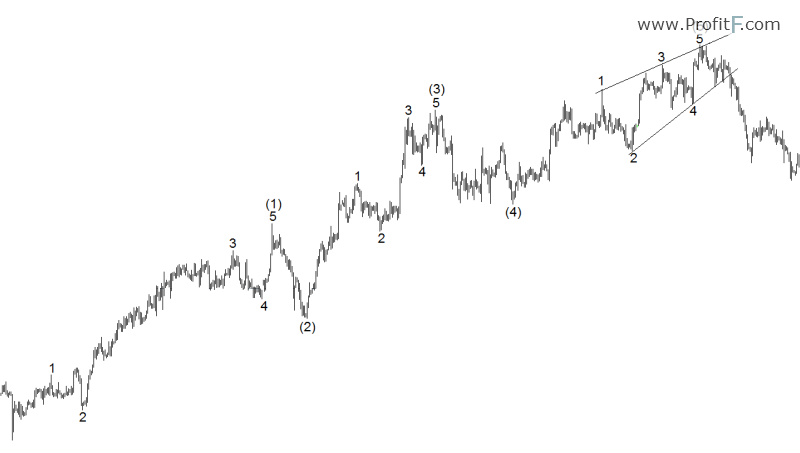
In a five-wave impulse, the ending diagonal in wave 5 looks like the one

 京公网安备 11010802022788号






