


 发帖
发帖
 雷达卡
雷达卡


Here 'e' is defined as the price of one unit of foreign currency in terms of the domestic currency.
Using this definition, the trade balance denominated in domestic currency, with domestic and foreign prices normalized to one, is given by:
Nx = X − Qe
where X denotes exports, and Q imports.
Differentiating with respect to e gives:

Dividing through by X:

At equilibrium, X = eQ. Therefore:

Multiplying through by e:

Which can be expressed as
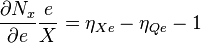
where ηXe and ηQe are common notation for the elasticity of exports and imports with respect to the exchange rate respectively.
In order for a fall in the relative value of a country's currency (i.e. a rise in e using the above definition) to have a positive effect on that country's trade balance, the left hand side of the equation must be positive (i.e. for a rise in e to cause a rise in Nx)
Therefore:
0 \Rightarrow \eta_{Xe} - \eta_{Qe} > 1 " src="http://upload.wikimedia.org/math/d/5/8/d58914bf58dbcd7859d4ccd0ebdf7ab6.png">
Which can be written as:
1 " src="http://upload.wikimedia.org/math/8/3/0/830884b6bf30ca4a1361ec692e2242e7.png">





 京公网安备 11010802022788号






