Wall Street Isn't Fixed: TBTF Is Alive And More Dangerous Than Ever Submitted by Tyler Durden on 08/06/2014 18:33 -0400 AIG BAC Bank of America Bank of America Bank Run Bear Stearns CDS Citigroup Discount Window Fail fixed Fractional Reserve Banking Free Money Gambling LBO Lehman Main Street Meltdown Merrill Merrill Lynch Momentum Chasing Moral Hazard Morgan Stanley None TARP Too Big To Fail in Share 2 Submitted by David Stockman via Contra Corner blog, Practically since the day Lehman went down in September 2008 Washington has been conducting a monumental farce. It has beenpretending to up-root the causesof the thundering financial crisis which struck that month and toenact measures insuring that it would never happen again. In fact, however,official policy has done just the opposite. The Fed’s massive money printing campaignhas perpetuated and drastically enlargedthe Wall Street casino, making the pre-crisis gamblers in CDOs, CDSand other derivatives appear like pikers compared to the present momentum chasing madness. In a nutshell, the Fed’s prolonged regime of ZIRP and wealth effects based “puts” under risk assets has destroyed two-way markets. The market’s natural mechanism of risk containment and stabilization—-short sellers—has been driven from the casino. Accordingly, carry-trade speculators engorged with free money funding have taken the market to lunatic heights, while leaving it vulnerable to aviolentcollapse upon an unexpecteddrop because the market’s naturalbraking mechanism—shortsellers taking profits—-has been eviscerated. At the same time,the giant regulatory diversion known as Dodd-Frank has actually permitted theTBTF banks to geteven bigger and more dangerous. Indeed, JPM and BAC were taken to their present unmanageable size by regulators—ostensibly fighting the last outbreak of TBTF—who imposed or acquiesced to the shotgun mergers of late 2008. So now these sameregulators, who have spent four years stumbling around in the Dodd-Frank puzzle palace confecting thousands of pages of indecipherable regulations, slam their wards for not having sufficiently robust “living wills”. C’mon! This is just another Washington double-shuffle. The very idea that $2 trillion global bankingbehemoths like JPMorgan or Bankof America couldbe entrusted to write-upstandby plans fortheir ownorderly and antiseptic bankruptcy is not onlyjust plain stupid; italso drips with political cynicism and cowardice. If they are too big to fail, they are too big to exist. Period. Indeed, it is utterly amazing that adult legislators and regulators could even take the idea of a “living will” seriously—-let alone believe that they could possibly thwart the recurrence of another outbreak of so-called “financial contagion”. Yet so thick is the beltway cynicism and so complete is the K-Street domination of policy-making thata trite bureaucratic gimmick like the “living will” has become a major component of so-called macro-prudential policy. So there is nothing to do except go back to the fundamentals. First and foremost, the September 2008 meltdown was not a main street banking problem; it was a crisis confined to the canyons of Wall Street, owing to the fact that the gambling houses domiciled there had massively bloated their balance sheets with toxic assets and risky derivatives trades, and then funded these balance sheets leveraged at 30:1 with huge amounts of “hot money” in the form of repo and unsecured wholesale loans. As I demonstrated in the Great Deformation, the “bank run” was almostentirely in the Wall Street wholesale market. By contrast, therewas neverany danger ofretail runs at the corner branch bank offices, and the overwhelming majority of the7,000 main street banks did not own the kind oftoxic securitized assets that were roilingWall Street. In fact, the wholesale market runs in the canyons of Wall Street were actually a positive, economically therapeutic event.They had already taken out three of the recklessgambling houses—- Bear Stearns, Lehman and Merrill Lynch—-andwere fixingto finish off the remainder, that is, Goldman and Morgan Stanley. Had the market been allowed to finish off the work of the economic gods in late September 2008, the TBTF problem would have been substantially alleviated. Today there might have existed a half dozen “sons of Goldman” in the form of MA, trading, investment banking and asset management boutiques—run by chastened veterans who lost their lunch during the 2008 Wall Street cleansing. The excuse for Washington’s massive intervention against the free market in the form of TARP and the Fed’s monumental flood of liquidity, of course, is that the US economy was about to be annihilated by something called financial “contagion”. But that is a specious urban legend invented by the crony capitalists who controlled the Treasury and the money-printers who had fueled the housing and credit bubble at the Fed. As I have also shown, for example,AIG’s dozens of insurance subsidiaries were money good and would have been protected in bankruptcy by insurance regulators and capital maintenance rules, while settlement ofthe holding company’s fraudulent CDS insurance would have beenparceled out pennies on the dollar by a Chapter 11 judge to the dozen giant global banks who had stupidly attempted to turn toxic CDOs into AAA credits. Likewise, FDIC could have liquidated Citigroup’s regulated bank, while allowing the gamblers who bought thestock, bonds and other obligations of the holding company to face their just deserts. In short, TBTF became a “problem” to be ostensibly remediedwith bureaucratic malarkey like living wills primarily because Washington made it a problem—- by means ofits panicked bailouts ofWall Street in the fall of 2008. Indeed, the true solution to TBTF is always and everywhere toallow the free market to cleanse its own excesses and imbalances and toimpose financial discipline and demiseupon outbreaks ofreckless gambling and leverage when they occur. Unfortunately, even if Washington were to refrain from ad hoc bailouts, the free market cure would be perennially compromised by the giant moral hazard posed by deposit insurance and the Fed’s cheap money discount window. Owing to these policyinstitutions, which systematically encourage excessive gambling by their beneficiaries, US banksare inherent wards of the state—including the easily abused privilege of fractional reserve banking conferred byregulatory charters. The right thing to do would be to abolish these sources of moral hazard and tell the K-Street financial lobbies to fold up theirplush tents because their employers are now all expected to sink or swim on the free market. Needless to say, the chances that Washington would permit the Wall Street gambling houses to bereturned to the unfettered free market that they profess to defend—are somewhere between slim and none. Accordingly, a second best solution is warranted, and it could readily be done.And it would be far more effective than the lunacy of living wills and all the other bureaucraticmumbo-jumbo that has come out of Dodd-Frank. First, Washington shouldre-enacta strict version of Glass- Steagall. Only “narrow banks” which take deposits and make consumer and business loans would have access to the Fed’s discount window. By contrast, propriety trading, underwriting, merchant banking, asset management and all the rest of the financial services sectors would be banned at regulated banks and sent back to the free market where they belong. Secondly, a ceiling on regulated bank size would be established —perhaps measured at 1% of GDP or $200 billion in terms of asset scale.There are no demonstrated economies of scale in deposit and loan banking above that size, anyway. Stated differently, banks wishing to indulge in the moral hazard of deposit insurance and accessing the Fed’s discount window would not have to prove they were not “too big to fail” or that they had a viable “living will”. Instead, a TBTF law would do it for them in the form of a statutory cap on the size of regulated banks. To be sure, Wall Street would scream that such a regime would interfere with the ability of small business and American consumers to get cheap loans.But in a national economy that has gone through a rolling 30-year LBO resulting in $60 trillion of credit market debt outstanding and which sportsleverage ratios against income in all sectors that are off the historical charts—that complaint has no merit. Making debt more expensive and permitting it to beeconomically priced on the free market is, in fact, just what is needed to eventually cure the nation’s debt-ridden economic malaise.
March Durable Goods Implode, Plunge -5.7%; CapEx Recovery Put On Indefinite Hiatus Submitted by Tyler Durden on 04/24/2013 08:47 -0400 Gross Domestic Product Reality recovery So much for the great American CapEx recovery. Moments ago the Census department released the March Durable Goods report, thanks to which one can lay to rest any hope of a recovery in the US economy, with the headline number printing an absolutely abysmal -5.7%, an epic swing from the +5.7% (revised lower of course to 4.3%) in February, and confirming the recovery is dead and buried. This was the biggest miss in headline data and the biggest drop since August, and the second worst since January 2009. Although we are confident the propaganda spin is just waiting to be unleashed: after all it is possible that March weather was both too hot and too cold, thereby making the number completely irrelevant - after all it is always the inclement weather's fault when the economy does not act as predicted by some economist's DSGE model of reality and stuff. This headline number was obviously a huge miss to expectations of -3%, with the misses spreading to all sub headline categories too: Durables ex-transportation was down -1.4%, on expectations of a 0.5% rise, (previous revised from -0.5% to -1.7%). And so much for CapEx with Cap Goods nondefense ex aircraft up just 0.2% (0.3% exp) with the previous revised from -2.7% to -4.8%, while the nondefense orders shipped ex air missed expectations of a 0.8% rise, printing at 0.3%, and the February data revised from 1.9% to 1.2%. In brief, horrifying economic data however one looks at it, and proof that the great CapEx recovery never existed to begin with. So much for 3% Q1 GDP, which is about to be revised by everyone lower across the board. Finally, if this economic collapse validation doesn't send the SP limit up, nothing will. The only two charts needed to show what is really going on in terms of capex and generally spending on core capex: Orders: Shipments:
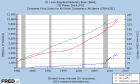
On Inflation, M2, and the Velocity of Money Submitted by CrownThomas on 08/10/2012 11:46 -0400 We often hear that the central banks printing money in order to keep the stock market inflated and broke countries afloat for just a few days longer is nothing to worry about. The reason we are given, is that even though the central banks are pumping trillions into the economy, inflation isn't an issue. And after all, the velocity of money has actually declined. That's the message from the "smart" people anyway. This chart shows that as M2 grows (Red), so does inflation ie: CPI (Green) - yes, this is the government's calculation, we'll leave it there for this chart's purpose. Also of note is the monetary base without the banking ponzi scheme of fractional reserve banking (Blue). So as you can see, inflation actually follows M2 growth, even as the velocity of money (below) declines. Don't be fooled by those who tell you that printing money isn't causing inflation, because it is doing just that each and every day. There are those who believe that velocity of money is a product of fast growing inflation (not a cause) . Inflation has been rising consistently with the growth in money supply, but the velocity of money has declined. You can imagine what happens once velocity of money actually starts to turn (hint: something ZH has been warning about for years). Similar Articles You Might Enjoy: Guest Post: Why QE Won't Create Inflation Quite As Expected On Gold As A Hyperinflation Put Jobless Claims Spike Is Fourth Largest In 2012 As Producer Prices Surge By Most Since June 2009 The Monetary Endgame Score To Date: Hyperinflations: 56; Hyperdeflations: 0 UBS Issues Hyperinflation Warning For US And UK, Calls It Purely "A Fiscal Phenomenon"
 标签: printing经管大学堂:名校名师名课

 京公网安备 11010802022788号
论坛法律顾问:王进律师
知识产权保护声明
免责及隐私声明
用户协议
京公网安备 11010802022788号
论坛法律顾问:王进律师
知识产权保护声明
免责及隐私声明
用户协议





