


 发帖
发帖
 雷达卡
雷达卡


Declaration of Great Harmony Society
1、 China breaking through monopoly and hegemonic blockadeIn 2018, two major events took place: one was the Sino US trade war, and the other was Baidu's announcement that it would open all the driverless platform technologies they developed free of charge. On the surface, these two events are independent events with little connection, but they are landmark events in the process of historical development.
China is a poor and backward country in the modern history of a semi colonial and semi feudal society that has gone through a hundred years of war. After 30 years of socialist transformation and 40 years of reform and opening up, it has so quickly entered the position of adversary with the United States, the number one country with capital hegemony. As the world's number one capitalist country, the United States has world military hegemony and currency hegemony. Since the 1970s, when European and American countries entered the capital surplus, they have made use of the credit value of capital to produce and easily ascended the throne of the world overlord of capital production. I thought that history would end from now on []However, it is suddenly found that China's rapid development has begun to catch up with and even surpass not only the whole industrial chain from low-end to high-end production, but also in aerospace, communications, new energy, intelligent robots and other aspects.
Although the trade war between the United States and China is only one of the means to counter China, it profoundly reflects the changes in the historical development trend that are difficult to detect. On the surface, the United States has unbreakable currency hegemony, capital monopoly and leading edge in science and technology. From the logic of capital production, this monopoly cannot be broken, let alone surpassed. However, its capital monopoly advantage has been quickly and easily broken by China. What logic works in it?
China's response to the US trade war shows that China has also entered the post capital production stage of overcapacity in terms of capital production mode, but China's capital production is not single. China's reform and opening up has introduced private capital production, but the original model of economic development led by the government has not changed. China is developing capital production and social (public) capital production at the same time, which is the only way to break the three-level monopoly formed by developed capitalist countries, including production monopoly, technology monopoly and financial monopoly. China's production has rapidly entered a position of parity with the world's hegemony, while the United States has hollowed out its domestic industry due to excessive "money printing and consumption", which has seriously threatened its military hegemony. This is the reason why the United States began to panic in 2018.
What artifact can break through the logic of capital so easily, making the three-level monopoly barrier of capital so vulnerable? It turned out to be the magical power of social (public) capital production. Although China has introduced private capital production and been influenced by those brainwashed by Western phenomenological economics who intend to use Neo liberal theory to guide the reform, the set of functions established in the previous 30 years that the government dominates the economy and plays the role of the government in providing a production environment for capital enterprises has not been reformed, and it has played the backbone role of the economy together with some retained monopoly state-owned enterprises. The Chinese characteristic lies in not only the positive role of private capital production in stimulating labor and capital in production, but also the mode of social (public) capital production and non capital value production based on the new social productivity of "Agglomeration production" (including two forms of value production of "Agglomeration effect" and "polymerization reaction"), and the traditional mode of capital production based on social productivity of "division of labor". Otherwise, how can we break the barriers built by the monopoly and hegemony of capital production under the condition that the production of capital is far behind that of the United States?
As a brand-new social productive force generated in the process of social development, why does "Agglomeration production" have such divine power? It turns out that when capital production has entered a highly developed stage, the socialization of production has become a common phenomenon, and any raw product may have an impact on the surrounding environment. For example, the application of pesticides in agricultural products, pollution emissions in industrial production, etc., if only the profit target in capital production, the negative environmental value production (or reaction force) in capital production will make capital production unsustainable. For example, computers, mobile phones, the Internet, high-speed railways, airports, urban infrastructure and so on, not only is the product's own value playing a role, but when the collection of products meets certain conditions, there will be "Agglomeration effect" and new value. In particular, the vast majority of human knowledge production is in the form of hidden value, forming the historical accumulation of human scientific and technological knowledge. Once a new production of knowledge and historical accumulation of knowledge combine to produce "polymerization reaction", it is in the form of explosive use value to provide for social consumption.
2、 The new social productive forces across capitalism have come into being
In contemporary society, a brand-new social productivity of "Agglomeration production" has been produced. The "Agglomeration production", which is opposite to the "division of labor" social productivity, is a kind of production. When the labor products that have been formed are gathered together with other labor products, the "Agglomeration effect" will occur. In knowledge production, when a knowledge product is produced, it does not necessarily have use value, so it must not become a commodity, but the accumulation of human historical labor that forms knowledge. Once a newly produced knowledge has "polymerization reaction" with these historical accumulated knowledge, the original value without use value will be combined with the new knowledge to produce a new use value, and its original hidden value will appear explosively. This new mode of production is unparalleled to the traditional productivity in terms of the productivity of value, because new knowledge labor can make the labor value of knowledge accumulated in human history play a role through the production of use value.
The combination of the traditional "division of labor" based capital production mode and the new "Agglomeration production" based social (public) capital production mode and non capital value production mode has a more powerful value production capacity for the simple capital production mode. Knowledge production in "Agglomeration production" is no longer limited by labor time and workplace as in "division of labor" production, and its expenditure on human labor resources is far lower than that of manual labor. People can use the unique mental labor of human beings all the time to create and accumulate labor value for society and all mankind. Sometimes a single labor may not produce useful products, but when these labor products are gathered together, they will certainly form new use value. In particular, the emergence of the Internet and the zero distance in the transmission of knowledge and information have created unprecedented convenience for human knowledge production.
Knowledge production is a kind of production. When people produce it, they often cannot form labor products with use value. Such labor products do not have exchange value, so they cannot form price. Labor products, which also embody the value of human labor, have no price, do not participate in the exchange as in capital production, and do not need distribution. They are the property shared by all workers. Only when the "polymerization reaction" occurs, their value and use value will explode. This is a big explosion of new productive forces. Only this big explosion of new productive forces can carry mankind into the Communist society.
Social production has value and use value, but there is no price. People can get consumption without distribution and exchange. From a small number of varieties in the past to today's (Musk's) SpaceX, Tesla, and (China's) Baidu, which are all free and open to the technology of their driverless vehicle platform, GPS and Beidou free navigation, the free and open access of massive information on the Internet, high-speed transmission, and online commerce free platform, they have begun to have a profound impact on human life, representing that today's world's non capital value production has entered a new stage.
Human beings engaged in knowledge production must be carried out on the basis of human inheritance and accumulation of knowledge, which is the means of production of human knowledge production. In production, everyone can use this means of production for their own production process at will, and can also use it as a means of consumption in the consumption process. This means of production is Ownerless and has no ownership relationship. Who owns it? It is the crystallization of the past work of all workers and is shared by all workers.
Is this not the communism we originally envisioned? All workers share the means of production? Does communism take what it needs and consume at will? But so far, this kind of production and consumption of the products produced are only limited to the knowledge production field of mental labor, or some products in the high-tech field. Although there have been a large number of Communist sprouts in the production of knowledge products, at present, knowledge products in the high-tech field are mainly carried out in the environment of capital production mode.
At the same time, we cannot ignore the fact that all the features of products that can achieve communism are that their use value will not disappear because of one use, but can be reused by different people at different times and places. As the means of production, knowledge products have this feature. The use value of knowledge inherited and accumulated by human history is infinite and reusable. When the knowledge of historical inheritance and accumulation is combined with new knowledge labor to produce products with new use value, if they are also characterized by infinite reusability, such as GPS navigation, when used by some people, it does not affect the infinite reusability of others at different times and places. Such products with infinite reusability will also have the consumption attribute of communism, even if they are products produced by capital.
At the same time, we should also see that in the products with one-time resource consumption and one-time use value, and in the exclusive products with different individuals and groups that can not share use value, no shared attribute can be generated in any case. Among these products with one-time use value and products with exclusive use value, because of one-time consumption and exclusive consumption, the use value will disappear for the users. If other subjects want to obtain consumption, the society must reproduce, which will inevitably lead to the problem that workers' labor must be compensated. In this case, it shows that the mode of capital production is still indispensable, otherwise, the society will not be able to achieve sustainable reproduction. Therefore, whether the society can produce the vast majority of consumer goods with unlimited reusable value is regarded as the node of whether communism can be realized.
At present, although the capital crisis in developed capitalist countries is constant and the trade war is in full swing, we also usher in the dawn of non capital value production. This production of non capital value is no longer the production of primitive society, slave society and feudal society, but the production of non capital value, which has been highly developed in social productivity and can no longer accommodate private property in capitalist society, has grown out of the capital production.
It turns out that we have always called this beautiful society the Communist society of great harmony. People describe the Communist great harmony society as the practice of public ownership of the means of production, taking what they need, distributing it according to their needs, and greatly enriching the material wealth of the society. However, the communism associated with the non capital value production mode growing out of capital production is different from the communism we originally envisaged.
First, the production of non capital value starts from the disappearance of price in commodity production. Due to market competition, the price of goods produced by capital first disappears in mental labor and knowledge production, which occupy less physical resources of workers. The embedded value of goods produced by capital began to be generally higher than the exchange price, and then among the knowledge products accumulated in human history, when their use value has the characteristics of unlimited reuse, the product may be open to the public for free under the guidance of the government serving the people. Although the value accumulated in the history of this product is very huge, it may also be equally huge in the real investment.
This kind of free use product in society has a common feature: there is no exchange, no price, and no traditional ownership relationship. Therefore, it is impossible to take private ownership through power. This is not consistent with our original assumption that communism is the ownership of public ownership. However, this is exactly what Marx envisioned. After the high development of capitalism, communism will inevitably be bred in the capital production.
The mode of production, which carries the ideal society of mankind, has come quietly and inadvertently. The unprecedented development of social productive forces awakened by capitalism has not only created a great wealth of human material life, but also created a high degree of development of science and technology. However, capital production has lost profits due to the constant disappearance of prices. Overcapacity, and then capital surplus. Capitalism has made capital production brilliant again for a while by using the means of credit value production, but now it has shown difficulty. In the interior of capital production, non capital value production is constantly accumulating and expanding.
However, we should not think that capitalism will die immediately because of overcapacity. Because there is still a huge gap between capital production and complete non capital production. This gap is whether human beings can produce all or most of the consumer goods with unlimited reusable value. Without a qualitative leap in social production, it is impossible to cross this gap.
So far, the production of non capital value is only limited to the field of knowledge production, because the knowledge product itself has the attribute of unlimited reusable value. As long as any product has the attribute of unlimited reusable value, it can be shared and consumed according to its needs. All products that need to consume the labor time resources of workers for continuous reproduction must be produced by means of capital production. Because capital production can only be carried out through "division of labor", it is necessary to compensate the labor value of workers through exchange, so that production can continue. Therefore, it is necessary to enter consumption through distribution, otherwise, production will inevitably be interrupted and unsustainable. In the production field of such products, production labor and consumption are still private, and it is impossible to provide sharing and free consumption.
In the past, people looked at the private ownership and public ownership of the means of production as crossing the gap between capitalism and communism. Now it seems that there is a problem. Because even the public ownership of the means of production is still based on the social productive force of "division of labor". On the basis of the social productive force of "division of labor", only capital production relations can be generated, because its products must be exchanged to compensate the labor value of workers. As long as there is exchange, the ownership relationship of product ownership must exist. Public ownership or private ownership, in fact, is only the scope of ownership is different, and the possession of social groups is essentially just a kind of private ownership with enlarged scope. In reality, public ownership sometimes mutates from ownership of power. Therefore, as long as there is ownership of the product, labor exchange is inevitable, and it is impossible to get what you need, so it is impossible to realize communism on this basis.
It can be seen that public ownership of the means of production is not a condition for the realization of communism. Public ownership of means of production is still based on the "division of labor" as the basis of social productivity, and is still the mode of capital production in essence. From capital production to non capital production, from capitalism to communism, it is obviously not as simple as private ownership and public ownership of the means of production.
It is precisely because there is a huge gap between capitalism and communism. Therefore, Richard pipes, a professor in the History Department of Harvard University in the United States, believes that "communism is a very bad fantasy". This also stems from the impossibility of building communism on the basis of public ownership of the means of production. Because both public ownership of the means of production and private ownership of the means of production are based on the social productive force of "division of labor", which can only produce capital production. Public ownership of means of production and private ownership of means of production are both within the scope of capital production. The fundamental reason for the failure of socialism based on the theory of public ownership of the means of production in the past is this.
Theoretical errors led to the failure of the Communist movement in the past, and made the most determined Communists lose confidence in communism. Communism once became a taboo word for some people. In the ideological bubble formed by modern (Western) Economics, the thoughts of most economists have also been ossified, so that the germination of communism in the world today can not be seen!In the ideological bubble formed by modern (Western) Economics, the thoughts of most economists have also been ossified, making it invisible to the budding communism that has emerged in the world today!
3、 The traditional old ideology cannot stop the pace of history
The Communist Manifesto written by Marx 170 years ago declared that communism was inevitable. Later, through the revelation of the general process of capital production in capital, the inevitability of communism was scientifically explained from the level of the objective law of social development. Marx is the first in human history to scientifically predict the inevitable demise of capitalism, rather than saying that capitalism is "the end of history" as Francis Fukuyama, a professor at Harvard University in the United States, said at an inappropriate time in the contemporary era when new socialism has sprouted in the interior of capital production in the 21st century.
Modern (Western) Economics, as an empirical theory, started from attacking Marx to demonstrating that the mode of production of capital is permanent, which was produced to maintain the needs of the capitalist system. From the beginning, it fell into the deviation of the theoretical methodology of negating the labor theory of value, and then entered the dead end of the price production theory of the superficial phenomenon of macroeconomics. This theory can not explain all kinds of economic phenomena after capitalism entered the stage of credit value production, nor can it save the crisis of capital production contraction faced by contemporary capitalism. Many superstitious people, including those in China's Neo liberal economics, have made the mistake of dogmatic copying modern (Western) Economics, causing losses to social and economic development. Modern (Western) Economics, as a superficial phenomenon economics and empirical theory, has also played a positive role in guiding the national economic development in the early stage of the development of capitalism. With the capital production entering the stage of overall surplus of capital, due to the denial of the origin of labor value, it has finally become a force hindering social and economic development, not only in Europe and the United States, but also in China.
It is bound to be completely liberated from the traditional and outdated old economic system. Otherwise, mankind will be unable to extricate itself from the quagmire of crisis and sub crisis! The shrinkage of capital production will form a self-excited cycle, which must be supported by new and higher social productivity, so that social development can be sustainable.
Just as the self-sufficient production in feudal society has not been completely eliminated after the emergence of the capital production relationship, and it still continues in some production and labor fields such as housework, in socialist society, the capital production mode will not completely disappear, and even in the Communist society at the advanced stage of socialist society, the capital production mode may still exist. The reason is that as the basis of social productivity of communism, "Agglomeration production" still needs to be based on social production of "division of labor". Therefore, private production and private consumption still exist within a certain range. People can only imagine that they can achieve their own needs in the main consumer goods of human survival and life, but not in all aspects. Otherwise, a society without differences may also lose labor incentives and the power of social development.
Communism sprouted just when people lost confidence, and sprouted in the deepest part of the capitalist fortress. The communism predicted by the gifted Marx more than 100 years ago will inevitably emerge in the most developed capitalism, which has been proved to be the case in reality.
New social productive forces have emerged. The new social productive forces, which are based on "Agglomeration production" higher than the social productive forces of "division of labor", have been widely playing a role in creating value. In reality, a variety of free services, shared consumption of navigation services such as Beidou and GPS, rapid information transmission on the Internet, free services for massive information, free platforms for online commerce, and free platforms for a variety of driverless technologies have been involved in many aspects of human life. With the rapid development of science and technology, new free stock services and shared consumption are also expanding and growing. The new social productive forces will eventually push human society to communism through quantitative change to qualitative change.
Nevertheless, we must not think that the realization of communism will be easy. So far, history has proved that socialism is the production of private capital, state-owned capital, social (public) capital and non capital value. Among them, the mode of production of capital has not died in the historical stage of socialism, and has even become the basis of the mode of production of social (public) capital. It can be seen that capital production still has its tenacious vitality.
The theory of socialism in the past ignored the study of the use value characteristics of social products. Communism can only be realized in the production of products with unlimited use value. In order to achieve the ability of producing products with unlimited use value, society must have incentives for workers' labor. The capital production mode is still the only production mode with incentives for both capital and labor. Moreover, the social productivity of "division of labor" is still the basis of the social productivity of "Agglomeration production". Although "Agglomeration production" is higher than the social productivity of "division of labor", it is based on the social productivity of "division of labor". It can be seen that communism is based on the social productivity of the combination of "division of labor" and "Agglomeration production", rather than a single "Agglomeration production" social productivity. Therefore, the productive forces and relations of production of communism are far more complex than we originally imagined. Not only does there not exist the kind of public ownership originally envisaged, on the contrary, a certain range of private ownership may still exist. It can be predicted that this must not be a single sharing and complete separation of needs.
4、 A bridge linking capital production and communism
Just as the self-sufficient production in feudal society has not been completely eliminated after the emergence of the capital production relationship, and it still continues in some production and labor fields such as housework, in socialist society, the capital production mode will not completely disappear, and even in the Communist society at the advanced stage of socialist society, the capital production mode may still exist. The reason is that as the basis of social productivity of communism, "Agglomeration production" still needs to be based on the mode of production of "division of labor". Therefore, private production and private consumption still exist within a certain range. People can only imagine that they can achieve their own needs in the main consumer goods of human survival and life, not in all aspects. Otherwise, a society without differences may also lose labor incentives and the motivation for social development.
Some people may ask that this does not mean that private ownership still exists forever? Can the Communist world of great harmony still be realized?
Modern (Western) economics is trying to demonstrate that rational economic man is selfish, so private ownership is eternal and communism is impossible to achieve. These people do not understand that human economic behavior is first and foremost subject to the mode of production, and even human nature is also subject to the mode of production. Communism in primitive society why is human nature not selfish? People's traditional ideas and ways of thinking formed by the old mode of production often lag behind the objective reality of the current society. Only the pioneers of thought can be keenly aware that the content and form are completely different. From the perspective of historical development trend, three major changes have taken place in the historical development trend of contemporary society:
First, contemporary capital production has entered a stage of overall overcapacity and capital surplus. Excess capital means the death of the surplus capital, which limits the space for the continued development of capital production. When mankind is solving the crisis and seeking development, the mode of production organization will change, and the new mode of production will gradually grow from the bud in the old mode of production.
Second, the brand-new social productivity of "Agglomeration production" has begun to emerge in the old mode of capital production. The production of social (public) capital and the production of non capital value are based on the new social productivity of "Agglomeration production". These two modes of production, not only in the socialist country - China, have become the main components of the contemporary four major value production, but also in the developed capitalist countries, have generally become an increasingly important component of social production. The products produced by this mode of production have value but no price. Because it enters people's consumption without exchange or distribution, it shows that communism has sprouted in the developed capitalist countries.
Third, mankind has not only reached an unprecedented level in science and technology in the fields of electronic technology, information communication, space technology, bioengineering, precision manufacturing, nuclear physics and new energy, but more importantly, mankind has begun to enter the field of artificial intelligence, which will bring a communist world of harmony to mankind.
Under the condition of capital production, the rapid growth of the robot market is due to the fact that using robots to replace people to do repetitive labor can save labor costs and improve capital profits, but objectively, it has caused the rapid growth of the robot market and is developing in the direction of intelligent robots.
Industrial robots that replace human repetitive labor can make the social products that human beings need to pay for repetitive labor grow explosively and rapidly reach the level of overcapacity. At this point, we must change the relations of production, especially the distribution relations, which must adapt to the development level of productivity. The production capacity of intelligent robots is far beyond the traditional productivity because it is not a direct living labor expenditure and is not restricted by the amount of living labor. Therefore, consumer goods produced by intelligent robots must have corresponding free consumption or shared consumption, or other corresponding forms of distribution of consumer goods. Otherwise, on the one hand, products without consumption will not be produced even with this production capacity under the condition of intelligent production, which will affect the development of productivity due to insufficient consumption; On the other hand, if intelligent robots produce a large number of products instead of distributing them free of charge for human consumption, overproduction will turn into a disaster. Here, the Marxist productive forces determine the relations of production, and the dialectical relationship of the reaction of the relations of production to the productive forces is very obvious.
The industrial robot itself is just an industrial product and a labor tool for workers. Although robots can replace human repetitive labor, on the one hand, complex labor can not be replaced by ordinary robots. Even intelligent robots also need a process of deepening intelligence. During this period, the production robot still needs the capital production mode of division of labor. However, because at this time, on the one hand, social products are greatly enriched, on the other hand, capital profits decline or even disappear. At this time, if we do not carry out the reform of socialist production and distribution mode, we can not solve the contradiction between production and marketing, and social production can not continue. It is inevitable for socialist production and distribution to adopt the mode of simultaneous development of the four major value production modes. Otherwise, the production and intelligent deepening process of intelligent robots will inevitably be blocked.
The mode of production in the socialist stage is the simultaneous development of private capital production, state-owned capital production, social (public) capital production and non capital value production. This simultaneous development of the mode of production is to not only give full play to the enthusiasm of labor and capital in the production of capital production, but also use social (public) capital production and non capital value production to replace the production of capital withdrawal when capital profits disappear, so that social reproduction can continue to develop in depth.
It can be seen that socialism is the bridge linking capitalism to communism. The era of intelligent robot production can only be realized under the conditions of socialist production mode and distribution mode. Because, on the one hand, it does not realize the comprehensive sharing of the use value of social products. Even in the production of robots, it still needs to be produced through the "division of labor", so it is necessary to compensate private labor through exchange and distribution, otherwise workers will lose their enthusiasm for production; On the other hand, the great abundance of consumer goods caused by robot production must be adapted to the improvement of production capacity by increasing the distribution and sharing of social welfare, otherwise, the production of intelligent robots will also be hindered. Because any overcapacity will lose the power of production development, and the same is true for the production of intelligent robots.
The era of intelligent robots is an era of extensive knowledge explosion. Although a small part of human knowledge production is carried out in the way of "division of labor", that is, the combination of use value and value can be realized in a single production to form a commodity (or patent), the vast majority is still produced in the way of "polymerization reaction". Under the condition that the "division of labor" production is still the basic production, the social productivity foundation of "Agglomeration production" must be the combination of social (public) capital production and non capital value production. This combined mode of production is one that is compatible with socialism.
As far as the ownership of means of production is concerned, the original knowledge, as the main means of production in knowledge production, is the accumulation and inheritance of human history and the common property of all workers. As far as the distribution relationship is concerned, all products produced by non capital value have value but no price. The reason why labor products without price have no price is that they are directly provided to social members for consumption without exchange and distribution. Since the contemporary society is a composite function of two social productive forces, namely "division of labor" and "Agglomeration production", and the four major modes of value production coexist, three forms will be adopted to realize this provision in specific forms:
The first is to include the value of free consumption in the commodity with price. When consumers buy this commodity, they get high value and low price. The value higher than the purchase price is the value of this non capital production.
The goods produced by capital can be consumed only through exchange. In a society where the four modes of value production coexist, the total value of this commodity consists of labor value produced by capital production means of "division of labor" and labor value produced by non capital production means of "Agglomeration production". The labor value of capital production can enter consumption only through exchange and distribution. When members of society buy such goods containing labor value produced by non capital value, because the value is greater than its price, the buyer pays only this part of the value produced by capital, and the labor value produced by non capital value does not need to make any payment. Thus, the free distribution of labor value produced by non capital value production is realized. It can be seen that the labor value of this non capital production is attached to the goods produced by capital, and is a free distribution based on the distribution of goods.
In this form, workers must participate in social production and work actively to obtain the right of free consumption. No, workers can not get the right of free consumption, which is conducive to mobilizing the enthusiasm of workers. This distribution pattern is suitable for the distribution of products with one-time use value and exclusive use value.
The second form is to provide products independently produced by non capital value production mode directly to national consumption free of charge. As it is a product independently produced by non capital value production mode, its product is characterized by value and no price at all, so it is directly provided to national consumption without exchange and distribution. It is mainly manifested in the production of human settlements, knowledge (knowledge is also an environmental product in a broad sense), and national welfare. The variety and coverage of products independently produced by non capital value production will continue to expand from small to large with the deepening of the socialist system. There is no quantitative boundary for environmental products, but there is a certain quantitative boundary for the product of national welfare, which is a balance between maintaining the enthusiasm of workers for production and labor and improving the needs of citizens for a better life.
The third form is that the products produced have (relatively) unlimited use value, which can be shared by all citizens. At present, products with unlimited use value are only concentrated in products with high knowledge intensity, such as various applications on the Internet, various navigation and human settlements products. All products with one-time use value or exclusive use value must be produced through capital production.
Through the provision of the above three forms of free consumer goods, it can be seen that in the socialist stage, the basic material conditions for human survival and life can not only be guaranteed, but also will be continuously improved in quantity and quality with the development of social production. However, the driving force of social sustainable development still depends on people's demand for higher material and spiritual life. Here, private ownership must exist, and there is also a difference between hard work and not hard work. People's needs for higher material and spiritual life still need to be met through personal efforts. Otherwise, the society will lose the power of development. Historical dialectics proves that the driving force of social development must be consistent with the driving force of consumer demand.
5、 Productivity node of communism
The accelerated development of science and technology will inevitably promote the development of robots to intelligent robots. The development of intelligent robots has liberated human beings from a large number of repetitive labor, so more people are mainly engaged in the production of intelligent robots, rather than directly engaged in the production of products with one-time resource consumption. Deepening the intelligence of intelligent robots will become the forefront of the development of science and technology. Finally, human beings will produce advanced intelligent robots to manufacture intelligent robots. When human beings produce advanced intelligent robots to manufacture intelligent robots, they will be completely liberated from the production of products with one-time use value and exclusive use value. The use value function of advanced intelligent robot is to manufacture intelligent robot, and then use this intelligent robot to engage in the production of consumer goods with disposable use value and consumer goods with exclusive use value. For advanced intelligent robots, the production of disposable consumer goods and exclusive consumer goods is just a function of the use value of advanced intelligent robots. Although the intelligent robot directly engaged in production at the front line is also limited by the service life, it can continuously produce such intelligent robots engaged in production at the front line. Therefore, for advanced intelligent robots, the production of disposable and exclusive consumer goods is no longer the product it directly produces, but its use value function. As long as human beings produce advanced intelligent robots, the exertion of its use value function is equivalent to the production of disposable and exclusive consumer goods, which has become an infinitely repeatable (relative) use value function. Therefore, through the intermediary of advanced intelligent robots, human beings have realized the unlimited and repeatable production of consumer goods with one-time use value and consumer goods with exclusive use value.
Through the full development of the productive forces with advanced intelligent robots as the main body, human beings have been liberated from the production of consumer goods with one-time use value and exclusive use value. Therefore, all the products that intelligent robots can produce are the functions of advanced intelligent robots with unlimited reusable value for human beings. In this scenario, we can get what we need and share consumption.
At the same time, we should also clearly see that the realization of the production of unlimited reusable value of human consumer goods is only the productivity condition for communism (the advanced stage of socialism). When there are still huge differences between countries in the world, and there is still a large gap between the rich and the poor within a country, communism cannot be realized. In other words, communism cannot be realized in a single country, nor can it leap directly from capitalism to communism. It needs an era of coexistence of capital production and non capital value production, which is the socialist society defined as the primary stage of communism. The social and historical conditions for the realization of communism are that all countries and nations in the world have already had the economic basis of fully developed socialist relations of production. Only on the basis of the high development of the general socialist society can communism take the lead in some countries (or regions).
In the Communist society, the main means of production for human production is the knowledge accumulated in human history. The accumulation of labor value of human knowledge belongs to labor products with value but no price performance. Therefore, there must be no ownership relationship, that is, it is neither public nor private. Therefore, human beings' access to this means of production for production must also be based on their own needs.
However, even if the means of production are used for production, it does not mean that there is no private ownership of workers' new labor input on this basis. Although communism takes what it needs from each other in terms of the necessities of human material life, it does not eliminate differences. Because although human beings have achieved the goal of taking what they need and sharing consumption in terms of basic survival and living conditions, they will certainly have a new pursuit in terms of higher-level consumption demand, otherwise, the society will lose the power of development. Therefore, private labor still exists, and the pursuit of new consumer demand at a new level is still the driving force of human hard labor. Social development lies in the constant pursuit of human beings to overcome the constraints of the environment and to emancipate themselves.
6、 Pioneer task in social change
The realization of the advanced stage of communism is a trend of historical development, but the concrete realization still needs the continuous efforts of the advanced social strata, arming the society with advanced ideology and theory, eliminating the backward ideology, and changing the relations of production to adapt to the productive forces of social development. Without the corresponding production relations and superstructure, the traditional old forces, old ideas and old ideologies will inevitably hinder the development of new social productive forces.
At present, although socialism has sprouted in developed capitalist countries and capital production has faced the crisis of capital death, the problem of peace and development in the contemporary world is still unresolved. Countries that represent monopoly capital interests and have established world hegemony, in order to maintain the position and interests of the world hegemony of capital, are still making wars and creating poverty and backwardness in all parts of the world, so that even the capital economy in these regions has not been fully developed, and poverty, backwardness, hunger, ethnic conflicts and wars have not been alleviated. At present, there are only a few developed capitalist countries that have entered socialism. The capital production of capitalism in most countries in Asia, Africa and Latin America has not yet fully developed, and it will take decades to fully develop. At present, the main and first thing in the world is to solve the problems of peace and development and the common prosperity of all countries. The task of the pioneers of socialism should work hard to reflect the new revolutionary theory of the inevitable law of historical development, to mop up the old and backward, traditional and conservative ideology, advocate win-win cooperation and oppose hegemonic struggle.
The struggle of capital hegemony originates from the production mode of capital with profit as the purpose of production, and gains the interests of market monopoly and financial monopoly through hegemony. All these come from the traditional ideology of maximizing capital interests. These hegemonic thinkers do not understand that under the circumstances of capital surplus, death and constant erosion of market prices, the only way to maximize capital interests is to start the production of social (public) capital, and continuing the traditional hegemonic thinking will only be counterproductive. The new social productive forces of "Agglomeration production" in the development of contemporary science and technology require the Republic of labor and capital, and the coexistence of capital production and social (public) capital production. Only cooperation can achieve win-win results. Because the value generation mode of "Agglomeration effect" and "polymerization reaction" can only occur when many labor products are aggregated together. Win win cooperation is the basic requirement of the socialist mode of value production. In the past, no matter the war between laborers and capital, or the war between monopoly capital and market competition, it is an old and backward ideology formed by the relationship of capital production, which is incompatible with the internal requirements of the socialist mode of production. Continuing war under the conditions of socialist relations of production will seriously hinder the development of society.
Although the socialist mode of production will grow inside the capital mode of production, and it is possible to make a peaceful transition from the capital mode of production to the socialist mode of production, it does not rule out the war imposed by monopoly capital on socialism to prevent the development of the socialist mode of production. This war to clear the way for the development of social history will obviously promote the development of social history.
Social reform must first take thought as the guide, must take the new ideology representing the development requirements of advanced social productive forces, and defeat the traditional ideology representing the interests of monopoly capital. New ideas, new ideas, and new ideologies that truly represent the requirements of the development of social advanced productive forces are often suppressed and stifled by traditional and old ideologies. Even in China, which has realized the socialist system, the traditional old ideology will also affect the country's macroeconomic decision-making because of cognitive problems. Habits and traditions often make people blind to the reality of development and change, and unconsciously become a force hindering the development of new social productive forces.
Thought is the forerunner of social revolution. Every major change of mankind cannot be separated from the guidance of advanced thought. The advanced social strata, advanced ideological theories and ideologies representing the advanced productive forces must rise up and fight resolutely against these old forces and ideologies, replace them with new ideologies, and make them aware of their future destiny and historical mission. Thus, social history can develop and advance. The inevitability of historical development also determines that only when new ideas and concepts representing the new productive forces of society rise up and fight, can they finally defeat these traditional old forces and ideologies and promote the development of social history.
Communism is not only an ideal human society, but also an inevitable trend of historical development. However, to realize it, there are still many problems about the imbalance of development, race and population, the earth's environment and ecology, and the possible alienation of intelligent robots, which are still unimaginable and should be dealt with. Human beings must adapt to the development requirements of social productive forces of "Agglomeration production" as soon as possible, establish international organizations with stronger coordination ability and wider cooperation, and meet these challenges through win-win cooperation.
We must use new ideas and theories to arouse the awakening of people around the world, occupy people's ideological positions with new ideologies that meet the requirements of new social productive forces, and respect human republicanism and win-win cooperation as the guiding ideology for human survival and development. In this way, we have reason to believe that communism and human harmony in the world will be realized!
Professor Cai Dingchuang
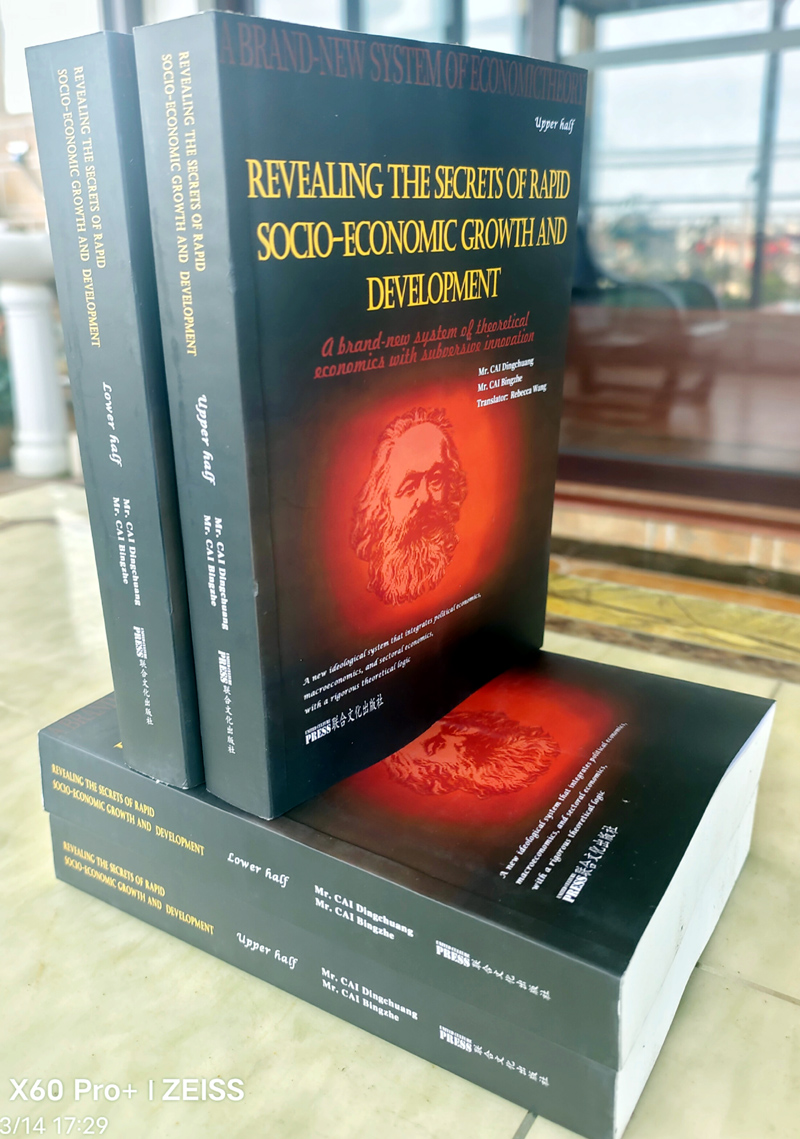
Academician of the World Academy of Wisdom Sciences, Guest Professor at Central University of Finance and Economics, and Author of Revealing the Secrets of Rapid Socioeconomic Growth and Development (RSGD)
Introduction to Cai Dingchuang, Author :
Academician of the World Academy of Wisdom, Visiting Professor at the Central University of Finance and Economics, and Founding Dean of the Chuangyuan Zhibo Economic Research Institute.
Professor Cai Dingchuang is a renowned contemporary Chinese theoretical economist. He currently serves as a Visiting Professor at the Central University of Finance and Economics and is an Academician of the World Academy of Wisdom. His major works include:
· Revealing the Secrets of Rapid Socioeconomic Growth and Development (Two Volumes, 2024)
· Credit Value Theory Sequel—Agglomeration Production and Capital Production (Two Volumes, 2024)
· Credit Value Theory—New Principles of Macroeconomic Theory (Two Volumes, 2020)
· Sequel to Capital—Credit Value Theory (2015)
· Monetary Puzzle (2010)
· Printing Money for Consumption (2011)
· Double-round economy (2013)
His Chinese publications exceed 3 million characters. In addition, he has published over 700 articles on finance, economics, and related topics in print and online media.
His economic theory centers on the concept of credit value production, integrating Marxist methodology with modern economic practices. He has developed an innovative theoretical system that combines political economy, macroeconomics, and applied economics. This system includes:
· Monetary theory
· Sovereign debt monetary theory
· "Double-round economy" framework theory
· "Printing money for consumption" theory
· Social (public) capital production theory
· "Agglomeration Production" theory of new social productive forces and its corresponding relations of production and five-distribution theory
· Theory of achieving a Great Harmony society
Professor Cai’s core contributions include the discovery of the credit value production mode within capital production and the identification of "Agglomeration Production" as a new social productive force that generates socialist relations of production and paves the way for a Great Harmony society. These groundbreaking discoveries in social science foundational theory have led to a comprehensive rewriting of political economy and macroeconomic theory, as well as the establishment of a new theory of social development. His work not only offers new pathways for transitioning developing economies but also optimizes the direction of China’s economic policies.
He has lectured on these theories at the Central University of Finance and Economics. Currently, his theories are being applied in various fields, including monetary policy, sovereign debt issuance, securities market reform, economic crisis resolution, and socioeconomic development transformation.
Introduction to Revealing the Secrets of Rapid Socioeconomic Growth and Development Content
This is a groundbreaking, fully innovative, and systematic new theory that subverts traditional economics, featuring rigorous theoretical logic and integrating political economy, macroeconomics, and sectoral economics into a unified framework. The work presents two major new theoretical discoveries:
(1) A new discovery regarding the contemporary credit-value production mode of capital production.
(2) The discovery of "Agglomeration Production" as a new form of social productivity, corresponding to the "division of labor" in social productive forces. These constitute significant breakthroughs in the foundation of contemporary world social science theory.
The discovery of these two fundamental theories completely overturns the cognitive models of traditional economics, leading to the revision and reconstruction of five major theories: monetary theory, sovereign debt monetary theory, exchange rate theory, virtual economy theory, and socialist theory. Furthermore, it establishes eight new theoretical frameworks, including:
· The "Double-Round Economy" structural theory
· The "Printing Money for Consumption" theory
· A new five-fold distribution theory
· The theory of social (public) capital production
· The theory of non-capital value production
· A three-tier macroeconomic framework theory
· The "Agglomeration Production" theory of new social productive forces
· The reconstruction theory of new production and distribution relations adapted to these new social productive forces
These theories reflect the fundamental laws of contemporary economic operation and possess universal applicability for countries around the world. They mark an end to the era where existing theories could neither explain modern global economic phenomena nor effectively respond to economic crises.
Whether in political economy or macroeconomics, this theory not only provides a perfect explanation of reality but also offers optimal solutions and rescue plans tailored to different real-world situations. It represents a major theoretical advancement addressing how societies can resolve issues of growth and development during periods of significant transformation, guiding societal evolution toward higher forms of social organization. The practice of this theory in China has already demonstrated its formidable efficacy.

 京公网安备 11010802022788号






