- 阅读权限
- 255
- 威望
- 0 级
- 论坛币
- 3804 个
- 通用积分
- 1.5037
- 学术水平
- 14 点
- 热心指数
- 9 点
- 信用等级
- 11 点
- 经验
- 1458 点
- 帖子
- 102
- 精华
- 1
- 在线时间
- 19 小时
- 注册时间
- 2006-5-13
- 最后登录
- 2016-12-10
|
- #######################################################
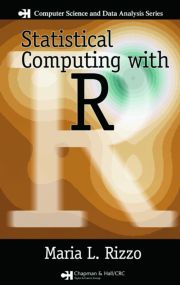
- ### Statistical Computing with R ###
- ### Maria L. Rizzo ###
- ### Chapman & Hall / CRC ###
- ### ISBN 9781584885450 ###
- ### ###
- ### R code for Chapter 3 Examples ###
- #######################################################
- ### Example 3.2 (Inverse transform method, continuous case)
- n <- 1000
- u <- runif(n)
- x <- u^(1/3)
- hist(x, prob = TRUE, main = bquote(f(x)==3*x^2)) #density histogram of sample
- y <- seq(0, 1, .01)
- lines(y, 3*y^2) #density curve f(x)
- ### Example 3.4 (Two point distribution)
- n <- 1000
- p <- 0.4
- u <- runif(n)
- x <- as.integer(u > 0.6) #(u > 0.6) is a logical vector
- mean(x)
- var(x)
- ### Example 3.5 (Geometric distribution)
- n <- 1000
- p <- 0.25
- u <- runif(n)
- k <- ceiling(log(1-u) / log(1-p)) - 1
-
- # more efficient
- k <- floor(log(u) / log(1-p))
- ### Example 3.6 (Logarithmic distribution)
- rlogarithmic <- function(n, theta) {
- #returns a random logarithmic(theta) sample size n
- u <- runif(n)
- #set the initial length of cdf vector
- N <- ceiling(-16 / log10(theta))
- k <- 1:N
- a <- -1/log(1-theta)
- fk <- exp(log(a) + k * log(theta) - log(k))
- Fk <- cumsum(fk)
- x <- integer(n)
- for (i in 1:n) {
- x[i] <- as.integer(sum(u[i] > Fk)) #F^{-1}(u)-1
- while (x[i] == N) {
- #if x==N we need to extend the cdf
- #very unlikely because N is large
- logf <- log(a) + (N+1)*log(theta) - log(N+1)
- fk <- c(fk, exp(logf))
- Fk <- c(Fk, Fk[N] + fk[N+1])
- N <- N + 1
- x[i] <- as.integer(sum(u[i] > Fk))
- }
- }
- x + 1
- }
- n <- 1000
- theta <- 0.5
- x <- rlogarithmic(n, theta)
- #compute density of logarithmic(theta) for comparison
- k <- sort(unique(x))
- p <- -1 / log(1 - theta) * theta^k / k
- se <- sqrt(p*(1-p)/n) #standard error
- round(rbind(table(x)/n, p, se),3)
- ### Example 3.7 (Acceptance-rejection method)
- n <- 1000
- k <- 0 #counter for accepted
- j <- 0 #iterations
- y <- numeric(n)
- while (k < n) {
- u <- runif(1)
- j <- j + 1
- x <- runif(1) #random variate from g
- if (x * (1-x) > u) {
- #we accept x
- k <- k + 1
- y[k] <- x
- }
- }
- j
- #compare empirical and theoretical percentiles
- p <- seq(.1, .9, .1)
- Qhat <- quantile(y, p) #quantiles of sample
- Q <- qbeta(p, 2, 2) #theoretical quantiles
- se <- sqrt(p * (1-p) / (n * dbeta(Q, 2, 2)^2)) #see Ch. 2
- round(rbind(Qhat, Q, se), 3)
- ### Example 3.8 (Beta distribution)
- n <- 1000
- a <- 3
- b <- 2
- u <- rgamma(n, shape=a, rate=1)
- v <- rgamma(n, shape=b, rate=1)
- x <- u / (u + v)
- q <- qbeta(ppoints(n), a, b)
- qqplot(q, x, cex=0.25, xlab="Beta(3, 2)", ylab="Sample")
- abline(0, 1)
- ### Example 3.9 (Logarithmic distribution, version 2)
- n <- 1000
- theta <- 0.5
- u <- runif(n) #generate logarithmic sample
- v <- runif(n)
- x <- floor(1 + log(v) / log(1 - (1 - theta)^u))
- k <- 1:max(x) #calc. logarithmic probs.
- p <- -1 / log(1 - theta) * theta^k / k
- se <- sqrt(p*(1-p)/n)
- p.hat <- tabulate(x)/n
- print(round(rbind(p.hat, p, se), 3))
- # The following function is a simple replacement for
- # rlogarithmic in Example 3.6
- rlogarithmic <- function(n, theta) {
- stopifnot(all(theta > 0 & theta < 1))
- th <- rep(theta, length=n)
- u <- runif(n)
- v <- runif(n)
- x <- floor(1 + log(v) / log(1 - (1 - th)^u))
- return(x)
- }
- ### Example 3.10 (Chisquare)
- n <- 1000
- nu <- 2
- X <- matrix(rnorm(n*nu), n, nu)^2 #matrix of sq. normals
- #sum the squared normals across each row: method 1
- y <- rowSums(X)
- #method 2
- y <- apply(X, MARGIN=1, FUN=sum) #a vector length n
- mean(y)
- mean(y^2)
- ### Example 3.11 (Convolutions and mixtures)
- n <- 1000
- x1 <- rgamma(n, 2, 2)
- x2 <- rgamma(n, 2, 4)
- s <- x1 + x2 #the convolution
- u <- runif(n)
- k <- as.integer(u > 0.5) #vector of 0's and 1's
- x <- k * x1 + (1-k) * x2 #the mixture
- par(mfcol=c(1,2)) #two graphs per page
- hist(s, prob=TRUE)
- hist(x, prob=TRUE)
- par(mfcol=c(1,1)) #restore display
- ### Example 3.12 (Mixture of several gamma distributions)
- # density estimates are plotted
- n <- 5000
- k <- sample(1:5, size=n, replace=TRUE, prob=(1:5)/15)
- rate <- 1/k
- x <- rgamma(n, shape=3, rate=rate)
- #plot the density of the mixture
- #with the densities of the components
- plot(density(x), xlim=c(0,40), ylim=c(0,.3),
- lwd=3, xlab="x", main="")
- for (i in 1:5)
- lines(density(rgamma(n, 3, 1/i)))
- ### Example 3.13 (Mixture of several gamma distributions)
- n <- 5000
- p <- c(.1,.2,.2,.3,.2)
- lambda <- c(1,1.5,2,2.5,3)
- k <- sample(1:5, size=n, replace=TRUE, prob=p)
- rate <- lambda[k]
- x <- rgamma(n, shape=3, rate=rate)
- ### Example 3.14 (Plot density of mixture)
- f <- function(x, lambda, theta) {
- #density of the mixture at the point x
- sum(dgamma(x, 3, lambda) * theta)
- }
- p <- c(.1,.2,.2,.3,.2)
- lambda <- c(1,1.5,2,2.5,3)
- x <- seq(0, 8, length=200)
- dim(x) <- length(x) #need for apply
- #compute density of the mixture f(x) along x
- y <- apply(x, 1, f, lambda=lambda, theta=p)
- #plot the density of the mixture
- plot(x, y, type="l", ylim=c(0,.85), lwd=3, ylab="Density")
- for (j in 1:5) {
- #add the j-th gamma density to the plot
- y <- apply(x, 1, dgamma, shape=3, rate=lambda[j])
- lines(x, y)
- }
- ### Example 3.15 (Poisson-Gamma mixture)
- #generate a Poisson-Gamma mixture
- n <- 1000
- r <- 4
- beta <- 3
- lambda <- rgamma(n, r, beta) #lambda is random
- #now supply the sample of lambda's as the Poisson mean
- x <- rpois(n, lambda) #the mixture
- #compare with negative binomial
- mix <- tabulate(x+1) / n
- negbin <- round(dnbinom(0:max(x), r, beta/(1+beta)), 3)
- se <- sqrt(negbin * (1 - negbin) / n)
- round(rbind(mix, negbin, se), 3)
-
-
- ### Example 3.16 (Spectral decomposition method)
- # mean and covariance parameters
- mu <- c(0, 0)
- Sigma <- matrix(c(1, .9, .9, 1), nrow = 2, ncol = 2)
- rmvn.eigen <-
- function(n, mu, Sigma) {
- # generate n random vectors from MVN(mu, Sigma)
- # dimension is inferred from mu and Sigma
- d <- length(mu)
- ev <- eigen(Sigma, symmetric = TRUE)
- lambda <- ev$values
- V <- ev$vectors
- R <- V %*% diag(sqrt(lambda)) %*% t(V)
- Z <- matrix(rnorm(n*d), nrow = n, ncol = d)
- X <- Z %*% R + matrix(mu, n, d, byrow = TRUE)
- X
- }
- # generate the sample
- X <- rmvn.eigen(1000, mu, Sigma)
- plot(X, xlab = "x", ylab = "y", pch = 20)
- print(colMeans(X))
- print(cor(X))
- ### Example 3.17 (SVD method)
- rmvn.svd <-
- function(n, mu, Sigma) {
- # generate n random vectors from MVN(mu, Sigma)
- # dimension is inferred from mu and Sigma
- d <- length(mu)
- S <- svd(Sigma)
- R <- S$u %*% diag(sqrt(S$d)) %*% t(S$v) #sq. root Sigma
- Z <- matrix(rnorm(n*d), nrow=n, ncol=d)
- X <- Z %*% R + matrix(mu, n, d, byrow=TRUE)
- X
- }
-
- ### Example 3.18 (Choleski factorization method)
- rmvn.Choleski <-
- function(n, mu, Sigma) {
- # generate n random vectors from MVN(mu, Sigma)
- # dimension is inferred from mu and Sigma
- d <- length(mu)
- Q <- chol(Sigma) # Choleski factorization of Sigma
- Z <- matrix(rnorm(n*d), nrow=n, ncol=d)
- X <- Z %*% Q + matrix(mu, n, d, byrow=TRUE)
- X
- }
-
- #generating the samples according to the mean and covariance
- #structure as the four-dimensional iris virginica data
- y <- subset(x=iris, Species=="virginica")[, 1:4]
- mu <- colMeans(y)
- Sigma <- cov(y)
- mu
- Sigma
- #now generate MVN data with this mean and covariance
- X <- rmvn.Choleski(200, mu, Sigma)
- pairs(X)
- ### Example 3.19 (Comparing performance of MVN generators)
- library(MASS)
- library(mvtnorm)
- n <- 100 #sample size
- d <- 30 #dimension
- N <- 2000 #iterations
- mu <- numeric(d)
- set.seed(100)
- system.time(for (i in 1:N)
- rmvn.eigen(n, mu, cov(matrix(rnorm(n*d), n, d))))
- set.seed(100)
- system.time(for (i in 1:N)
- rmvn.svd(n, mu, cov(matrix(rnorm(n*d), n, d))))
- set.seed(100)
- system.time(for (i in 1:N)
- rmvn.Choleski(n, mu, cov(matrix(rnorm(n*d), n, d))))
- set.seed(100)
- system.time(for (i in 1:N)
- mvrnorm(n, mu, cov(matrix(rnorm(n*d), n, d))))
- set.seed(100)
- system.time(for (i in 1:N)
- rmvnorm(n, mu, cov(matrix(rnorm(n*d), n, d))))
- set.seed(100)
- system.time(for (i in 1:N)
- cov(matrix(rnorm(n*d), n, d)))
- detach(package:MASS)
- detach(package:mvtnorm)
- ### Example 3.20 (Multivariate normal mixture)
- library(MASS) #for mvrnorm
- #ineffecient version loc.mix.0 with loops
- loc.mix.0 <- function(n, p, mu1, mu2, Sigma) {
- #generate sample from BVN location mixture
- X <- matrix(0, n, 2)
- for (i in 1:n) {
- k <- rbinom(1, size = 1, prob = p)
- if (k)
- X[i,] <- mvrnorm(1, mu = mu1, Sigma) else
- X[i,] <- mvrnorm(1, mu = mu2, Sigma)
- }
- return(X)
- }
- #more efficient version
- loc.mix <- function(n, p, mu1, mu2, Sigma) {
- #generate sample from BVN location mixture
- n1 <- rbinom(1, size = n, prob = p)
- n2 <- n - n1
- x1 <- mvrnorm(n1, mu = mu1, Sigma)
- x2 <- mvrnorm(n2, mu = mu2, Sigma)
- X <- rbind(x1, x2) #combine the samples
- return(X[sample(1:n), ]) #mix them
- }
- x <- loc.mix(1000, .5, rep(0, 4), 2:5, Sigma = diag(4))
- r <- range(x) * 1.2
- par(mfrow = c(2, 2))
- for (i in 1:4)
- hist(x[ , i], xlim = r, ylim = c(0, .3), freq = FALSE,
- main = "", breaks = seq(-5, 10, .5))
- detach(package:MASS)
- par(mfrow = c(1, 1))
-
- ### Example 3.21 (Generating variates on a sphere)
- runif.sphere <- function(n, d) {
- # return a random sample uniformly distributed
- # on the unit sphere in R ^d
- M <- matrix(rnorm(n*d), nrow = n, ncol = d)
- L <- apply(M, MARGIN = 1,
- FUN = function(x){sqrt(sum(x*x))})
- D <- diag(1 / L)
- U <- D %*% M
- U
- }
- #generate a sample in d=2 and plot
- X <- runif.sphere(200, 2)
- par(pty = "s")
- plot(X, xlab = bquote(x[1]), ylab = bquote(x[2]))
- par(pty = "m")
- ### Example 3.22 (Poisson process)
- lambda <- 2
- t0 <- 3
- Tn <- rexp(100, lambda) #interarrival times
- Sn <- cumsum(Tn) #arrival times
- n <- min(which(Sn > t0)) #arrivals+1 in [0, t0]
- ### Example 3.23 (Poisson process, cont.)
- lambda <- 2
- t0 <- 3
- upper <- 100
- pp <- numeric(10000)
- for (i in 1:10000) {
- N <- rpois(1, lambda * upper)
- Un <- runif(N, 0, upper) #unordered arrival times
- Sn <- sort(Un) #arrival times
- n <- min(which(Sn > t0)) #arrivals+1 in [0, t0]
- pp[i] <- n - 1 #arrivals in [0, t0]
- }
- #alternately, the loop can be replaced by replicate function
- pp <- replicate(10000, expr = {
- N <- rpois(1, lambda * upper)
- Un <- runif(N, 0, upper) #unordered arrival times
- Sn <- sort(Un) #arrival times
- n <- min(which(Sn > t0)) #arrivals+1 in [0, t0]
- n - 1 }) #arrivals in [0, t0]
- c(mean(pp), var(pp))
- ### Example 3.24 (Nonhomogeneous Poisson process)
- lambda <- 3
- upper <- 100
- N <- rpois(1, lambda * upper)
- Tn <- rexp(N, lambda)
- Sn <- cumsum(Tn)
- Un <- runif(N)
- keep <- (Un <= cos(Sn)^2) #indicator, as logical vector
- Sn[keep]
- round(Sn[keep], 4)
- ### Example 3.25 (Renewal process)
- t0 <- 5
- Tn <- rgeom(100, prob = .2) #interarrival times
- Sn <- cumsum(Tn) #arrival times
- n <- min(which(Sn > t0)) #arrivals+1 in [0, t0]
- Nt0 <- replicate(1000, expr = {
- Sn <- cumsum(rgeom(100, prob = .2))
- min(which(Sn > t0)) - 1
- })
- table(Nt0)/1000
- Nt0
- t0 <- seq(0.1, 30, .1)
- mt <- numeric(length(t0))
- for (i in 1:length(t0)) {
- mt[i] <- mean(replicate(1000,
- {
- Sn <- cumsum(rgeom(100, prob = .2))
- min(which(Sn > t0[i])) - 1
- }))
- }
- plot(t0, mt, type = "l", xlab = "t", ylab = "mean")
- abline(0, .25)
-
- ### Example 3.26 (Symmetric random walk)
- n <- 400
- incr <- sample(c(-1, 1), size = n, replace = TRUE)
- S <- as.integer(c(0, cumsum(incr)))
- plot(0:n, S, type = "l", main = "", xlab = "i")
- ### Example 3.27 (Generator for the time until return to origin)
-
- set.seed(12345)
-
- #compute the probabilities directly
- n <- 1:10000
- p2n <- exp(lgamma(2*n-1)
- - log(n) - (2*n-1)*log(2) - 2*lgamma(n))
- #or compute using dbinom
- P2n <- (.5/n) * dbinom(n-1, size = 2*n-2, prob = 0.5)
- pP2n <- cumsum(P2n)
- #given n compute the time of the last return to 0 in (0,n]
- n <- 200
- sumT <- 0
- while (sumT <= n) {
- u <- runif(1)
- s <- sum(u > pP2n)
- if (s == length(pP2n))
- warning("T is truncated")
- Tj <- 2 * (1 + s)
- #print(c(Tj, sumT))
- sumT <- sumT + Tj
- }
- sumT - Tj
|
|



 发帖
发帖
 雷达卡
雷达卡





 扫码
扫码 京公网安备 11010802022788号
论坛法律顾问:王进律师
知识产权保护声明
免责及隐私声明
用户协议
京公网安备 11010802022788号
论坛法律顾问:王进律师
知识产权保护声明
免责及隐私声明
用户协议






